×

Two Together: Save £100!Save £100 when you purchase two funeral plans together. Call us for more details.

Written by Betty Gardiner.
13 minute read
If you are planning a funeral for someone who has recently died, or you’re thinking ahead to your own final wishes, it’s natural to be curious about what is involved in the cremation process. Questions like “How long does a cremation take?” may enter your mind as you consider this funeral option.
While the cremation itself is a relatively straightforward process, various steps are involved before, during, and after to ensure everything is handled with care and respect. From legal requirements to the preparation and handling of ashes, each stage plays an important role in creating a meaningful farewell.
Key takeaways:
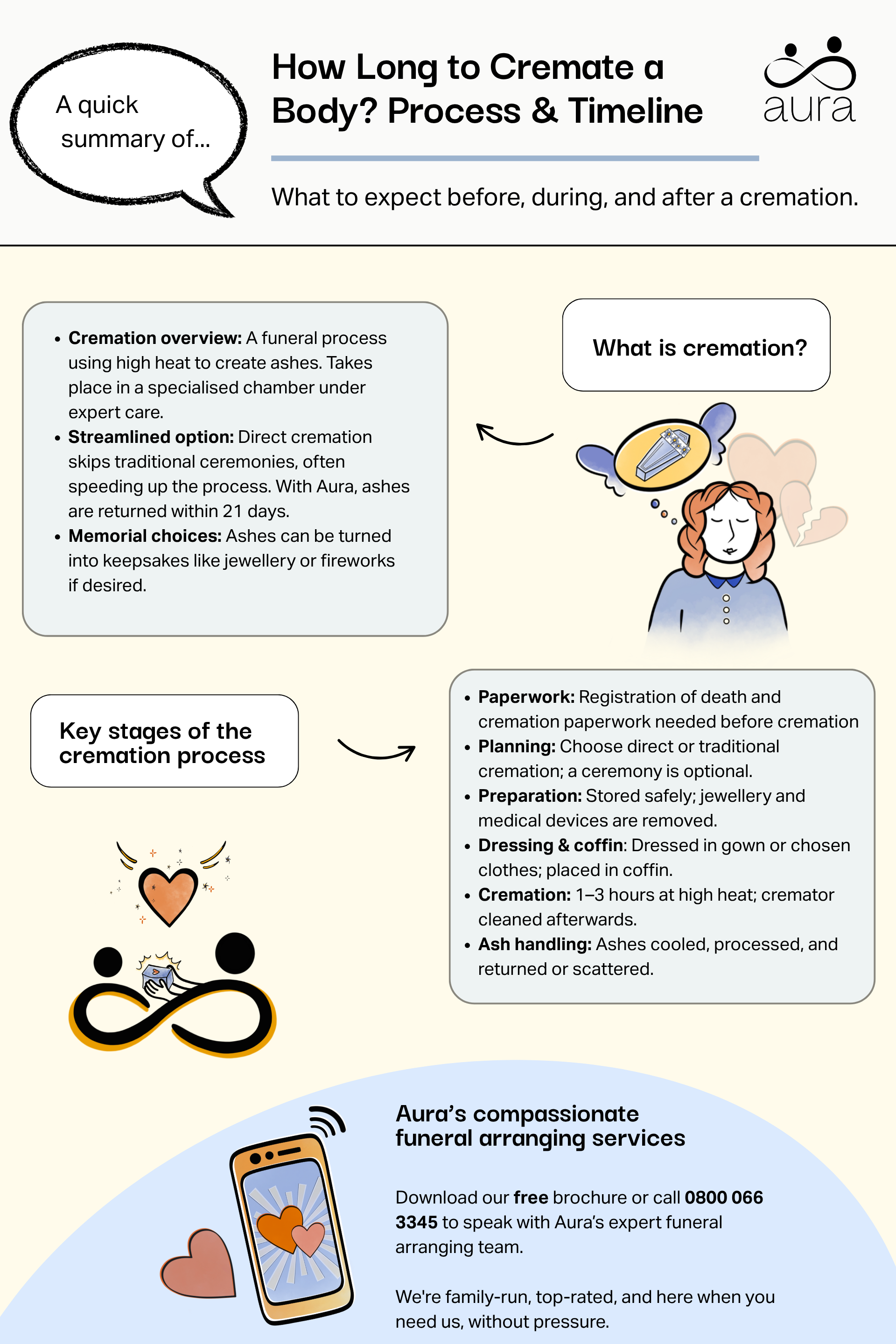
Cremation is a respectful way to handle someone’s body after they have died. They take place at crematoriums which can be found all over the UK. Here, professional mortuary experts place the person who has died inside a coffin and then into a special chamber. This chamber will be heated to extremely high temperatures in order to turn the person who has died into ashes.
In 2023, data from The Cremation Society shows that cremation was chosen for 80% of all funerals in the British Isles. It offers families a simple way to say goodbye to their loved ones as well as flexible options for memorials, as ashes can be transformed into many unique tributes like fireworks and special jewellery.
Every person’s funeral is as unique as they are and may involve different traditions and ceremonies. No matter what kind of funeral a person chooses, they will be treated with dignity and receive great care from professional staff members following a strict code of conduct for cremation.
Step 1: Paperwork
Before a cremation can proceed, the death must be registered with local authorities. This will involve a doctor and the local registrar. Once the necessary documents have been issued, funeral arrangements may proceed.
Step 2: Organisation
With the paperwork in order, the family of the person who has passed may choose the type of funeral that suits their needs. If the family decides to include a ceremony, they will work with a funeral director to organise the service, including selecting a venue, date, and celebrant.
Step 3: Care of the body
Before cremation, the body is carefully prepared. It is stored in a temperature-controlled environment, typically at a mortuary or funeral home. Any medical devices like pacemakers are removed as these can be hazardous during cremation. Jewellery, glasses and other items will also be removed. Anything the family wants to keep will be given to them, while the medical devices will be disposed of properly.
Step 4: Preparing the body
When the person who has died arrives at the crematorium, they may be dressed in clothing chosen by the family or a simple white gown. They will then be placed in a coffin, often made from combustible materials like wood or cardboard.
Step 5: Cremation
The coffin is placed into the cremation chamber and exposed to temperatures of 800°C to 1100°C. This intense heat reduces the body to bone fragments. Mortuary assistants will keep a close eye throughout, however, this is a relatively simple process that can be done automatically.
Step 6: Handling of ashes
After cremation, the ashes are collected, any remaining metal fragments are removed, and the ashes are placed into a container like an urn or a scatter tube. Families can collect the ashes from the crematorium or funeral director or have them hand-delivered for an additional fee. Many crematoria offer Gardens of Remembrance where ashes can be scattered for no charge.
The cremation process usually takes around one to three hours, depending on the size of the person who died, the type of cremator, and the materials used in the coffin. After this, there is a cooling period of one to two hours to allow the remains to be handled.
The full process from the collection of a person who has passed to handing their ashes back to a loved one can take a few days to a few weeks.
Collecting your loved one can typically take a few hours. Unless there are special circumstances, bodies can’t be kept at the crematorium overnight. This means arrangements must be in place beforehand so the cremation can occur on the same day as collection.
If you have arranged an attended cremation, this will often take place on the same day as the cremation. Most attended cremation services last up to 45 minutes but can be as short as 10 minutes for an intimate funeral depending on what you and your family decide is best for your circumstances.
Under very high heat, the person who has died and their coffin is burned within a few hours. After the cremation, the remaining fragments are collected, cooled, and processed into ashes. This entire process can take up to four hours in total.
After cremation, it may take an additional few days for the ashes to be prepared and ready to be sent to a family member or close friend. It will depend on your funeral provider. At Aura, we can arrange the hand-delivery of your loved one’s ashes within 21 days for a nominal fee.
Many families choose to hold the funeral service around one to two weeks after the person has died. This allows time for paperwork to be completed and for the cremation to take place, so the urn can be ready in time for the service.
If there’s an urgent need — for example, due to religious or cultural reasons — some providers offer a paid fast‑track service. This means the cremation is prioritised so everything can be arranged more quickly.
The size of the person who has passed will affect the time it takes to cremate them. Larger bodies generally require more time, often extending the process by 30 minutes to an hour. Fat tissue burns slower than muscle tissue which can result in needing more time in the cremator, or just being a taller, larger person can lead to more time added.
Additionally, certain medical implants, like pacemakers, must be removed before cremation as they can cause issues when heated to high temperatures. This can add more time to the preparation process before the cremation begins.
A person being cremated will typically go into the cremator in a coffin or container of some kind. Materials like pine, cardboard and wicker are normally used for cremation. This is because they burn quicker, are more affordable and can be more environmentally friendly. Thick and dense materials like solid wood take longer to burn and can lengthen the duration of a cremation.
If the cremation chamber can reach and maintain higher temperatures, this will speed up the duration of the cremation process. Modern cremators are more efficient as they use automated systems that optimise temperature and airflow, ensuring a faster cremation. Older or less efficient cremators may take longer to reach the desired temperature or maintain optimal conditions which will prolong the cremation.
Modern crematoria follow strict identity checks to ensure families receive the correct ashes. From the moment the person arrives, they’re given a unique ID — often a wristband or label on the coffin — which stays with them throughout. Staff check this ID at every stage, including before and after the cremation, and it’s attached to the container holding the ashes. Crematoriums follow national protocols to ensure accuracy, traceability, and dignity, with all steps carefully recorded and regularly reviewed to maintain trust and peace of mind.
While the actual cremation process takes only a few hours, several other factors can affect the overall timeline. From completing legal paperwork to handling ashes after the cremation, these considerations are essential and may add time to the process.
Before a cremation can be arranged, important legal steps must be completed. The first step is registering the death with your local registrar’s office within 5 days (8 days in Scotland). This usually involves a doctor issuing a Medical Certificate of Cause of Death or MCCD which is then provided to the registrar. The registrar can provide the family of the deceased with a death certificate and a “Green Form” (Certificate for Cremation or Burial), allowing funeral arrangements to proceed. The time frame for completing the necessary paperwork can differ based on location and circumstances. It may last between a few days to a few weeks.
Probate or estate management is another possible consideration. This process can take extra time, particularly if there are complications with the will and funds are needed from the person’s estate to pay for the funeral.
After the cremation, the remains inside the cremator are left to cool for several hours. Once cooled, the bone fragments are processed into fine ashes using a machine called the cremulator.
Any remaining metal pieces are removed with a magnet and the cremation chamber is cleaned thoroughly to ensure no cross contamination can occur. The ashes are then placed into a container, ready to be scattered in the Garden of Remembrance or hand-delivered to a loved one.
Busy crematoria may need to schedule cremations days or weeks ahead during peak periods. Incomplete paperwork—such as medical certificates—can delay the process.
Another option is to have a prepaid funeral plan. By having the funeral provider in place beforehand, the cremation process can proceed more quickly and smoothly, saving valuable time for your family.
With Aura, you and your family can expect compassionate support from our friendly team. As a family-run company, we understand what families need during difficult times and are dedicated to making the process as stress-free as possible. Our affordable and all-inclusive plans ensure everything is taken care of in advance, giving you peace of mind and relieving your family of future pressures.
If you have any other questions about prepaid funeral plans or direct cremations, our friendly team is happy to help. Please feel free to get in touch.



If you have any questions, would like a brochure or simply would like a chat through our services, our award-winning team is here to help.
Unlike other providers, we won’t hassle you with constant calls. We’ll simply ensure you have the information you need and leave you to come to a decision in your own time. When you’re ready for us, our team will be ready to help.
A cremation itself is not a very long process and can be quite easy to organise if complications like probate and a coroner’s inquest do not interrupt any plans. However, every funeral is unique and the length of time to arrange a funeral is hard to predict.
Several factors can influence duration:
Body size and composition
Coffin material (cardboard burns faster than hardwood)
Cremator efficiency
Legal paperwork or probate delays
Ashes are usually ready within a few days after cremation. At Aura, ashes are hand-delivered within 21 days (optional service).
In many cases, yes. Cremation can be organised more quickly, especially with direct cremation, which avoids waiting for a venue, clergy, or ceremonial preparations.
Each person is tracked with a unique ID and matching paperwork from the moment they enter the crematorium until their ashes are returned.
After someone dies, their body is cared for with dignity and respect until the cremation takes place. They are usually taken into the care of a funeral home or crematorium partner, where they are kept in a temperature-controlled environment such as a mortuary. This ensures the person is preserved safely while paperwork and arrangements are completed.
During this time, the body is gently prepared. Any medical devices that could pose a safety risk, such as pacemakers, are removed. Jewellery or personal items are taken off and returned to the family unless requested otherwise.
Before cremation, certain items are removed from the person for safety and practical reasons. These include:
Medical devices like pacemakers, defibrillators, or implants containing batteries — these can be hazardous if left in during cremation.
Jewellery and watches — families often choose to keep these items as mementos, and many materials aren’t suitable for the cremator’s high temperatures.
Eyeglasses and removable prosthetics — these are typically taken off before cremation begins.
All of this is done by trained professionals with great care, following a respectful and regulated process. Families are welcome to let their funeral provider know of any special wishes around these items.
The clothing worn during cremation depends entirely on the family’s wishes or the person’s instructions, if they left any.
Often, families choose to dress their loved one in something personal — perhaps a favourite outfit, pyjamas, or something symbolic or meaningful. Others prefer to use a simple gown provided by the funeral director. If no choice is made, the person is still clothed in a modest and respectful way.
Any non-combustible or harmful items (like metal zips or belts) may be removed or replaced to ensure safety during the cremation. All of this is handled discreetly and compassionately, ensuring the person is treated with dignity throughout.
There are ways you can make the cremation process faster if necessary. Opting for a direct cremation, which skips the traditional funeral service, can speed up the process. The cremation process can then be expedited as there is no ceremony or procession to organise.