×

Two Together: Save £100!Save £100 when you purchase two funeral plans together. Call us for more details.


Written by Adam McIlroy.
19 minute read

When someone close to us dies, it can bring us great comfort, once their cremation has been carried out, to have their ashes in our possession. However, sometimes, a death in a family can exacerbate underlying tensions, which can lead to conflict. This might lead us to wonder about ashes rights: who has them, what do they entitle us to, what happens if there is a dispute over ashes within a family. It’s those questions that we will aim to answer in this article.
We’d also just like to say that, if you are reading this, we recognise that you might be going through a difficult time. We’d like to let you know that, if you need to organise a funeral, we are able to help. Aura is the top-rated national ‘Cremation Services’ provider on Trustpilot with a rating of 4.9/5 stars, and we offer our funeral services to those in need now (through our direct cremation services) and to those thinking ahead to the future (through our prepaid funeral plans).
Key Takeaways:
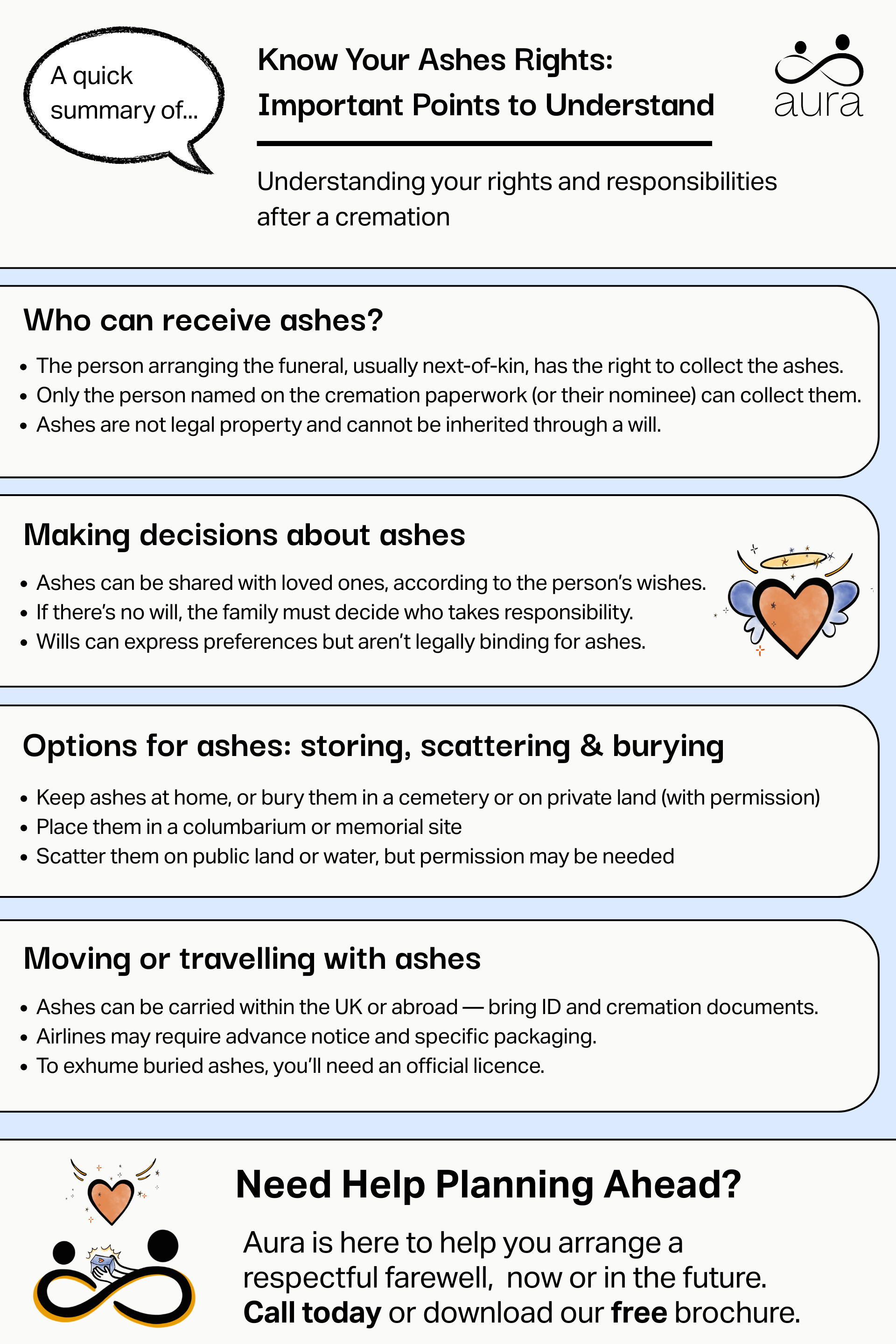
In general, the person who has the legal right to someone’s cremation ashes is the one who is organising the funeral. This is usually the next-of-kin of the person who has died.
The person who owns the ashes after a cremation has occurred is usually the person who has gone through the funeral arranging process. This is usually the next-of-kin of the person who has died, and they will normally have been the one who has registered the death, and who has contacted the funeral director. Interestingly, when writing a will, we cannot decide who gets to ‘inherit’ our ashes, as our body / cremated remains are not considered to be property legally speaking, and so cannot form part of the estate.
Under UK law, human remains are not legally classed as property. This is known as the “no property in a body” rule. It means that a human body or ashes cannot be owned, gifted, or passed on in a will as if they were an object or asset.
However, once cremation has occurred, there is legal nuance. Courts have recognised that the ashes – the result of a process involving human skill and care – can be considered the responsibility of the person who arranged the cremation. In practice, that person has the right to control what happens to the ashes.
Even though ashes aren’t technically part of the estate, any written or spoken wishes of the person who has died should be taken into account. These wishes aren’t legally binding, but should be respected wherever possible.
If the crematorium is not on the same premises as the funeral director, then the funeral director themselves can collect the ashes. They might do this if the ashes form part of their post-cremation service; for instance, Aura offers the option of hand-delivering ashes back to the family at home. However, instead of this people often prefer collecting the ashes themselves from the crematorium. Only the person who has signed the cremation forms can do this (usually the next-of-kin who is organising the funeral) or someone else who has been nominated on the forms.
Be prepared to show photo ID when collecting the ashes. If someone else is collecting them, they must be named on the cremation paperwork or have written permission from the person who arranged the funeral. Staff will typically request to see their identification and authorisation before releasing the ashes.
Crematoria do not keep ashes indefinitely. If no one collects the ashes within a certain timeframe (usually around 1-3 months), and no instructions were left, they may be respectfully buried or scattered on the crematorium grounds. If you need more time, inform the crematorium so arrangements can be made.
When completing the cremation paperwork, there is usually a section where you can state who should collect the ashes or what should happen to them. If possible, ensure this is filled in to avoid confusion later.
With more families choosing cremation, disagreements over ashes have become increasingly common. Many families each year face conflict over who should collect, keep, scatter, or bury the ashes.
Disputes may arise over a range of issues, including whether to cremate or bury, where the ashes should go (a family plot, home garden, or special place), who gets to keep or scatter them, the type of ceremony, and even the timing or religious aspects of the memorial.
Guidance on what to do with the ashes of a loved one who has died could perhaps be found in their will, if they have offered any view on the situation themselves. Please remember, however, that any relevant provisions therein don’t have the force of law. Disputes about ashes rights reveal the importance of talking about death and dying with your family and end-of-life planning in advance.
If a loved one left wishes about their ashes in a will, these can guide the family—but they are not legally binding. Disagreements should ideally be resolved through open conversation or mediation, as court proceedings can be emotionally and financially draining.
In rare, urgent cases, a family member can apply to the High Court for an injunction to pause cremation, burial, or scattering until the dispute is resolved. The Chancery Division of the High Court may ultimately decide who controls the ashes under Section 116 of the Senior Courts Act 1981. The court aims for a respectful, timely resolution, considering the deceased’s wishes, family views, and personal ties to locations.
The person holding the ashes is not their legal owner but is expected to act as a trustee—considering the wider family’s perspectives and the deceased’s preferences. While there’s no strict deadline to raise a dispute, it’s best to act quickly, as decisions like scattering or burial are often irreversible.
Ashes can be divided under the law in the UK, but, as in all matters relating to the cremains of someone who has died, respect for their personhood and wishes needs to be maintained at all times. Cremains should not be divided excessively, and, where possible, against the end-of-life wishes of the person who has died, as far as they are known. It’s a very common practice to disburse ashes among family members, so striking the balance between what is wanted by the family and what is right for the person who has died is very important.
If you’re considering splitting your loved one’s ashes among family members, it’s best to ensure all close relatives are comfortable with this decision. Doing so with mutual respect and consensus can help prevent further conflict or distress.
There is no legal requirement to divide ashes, and no one can be forced to do so. If there’s disagreement, the family may need to find a different compromise. If the deceased made specific wishes about splitting (or not splitting) their ashes, these should be honoured where possible.
Ultimately, dividing ashes is a personal choice. What matters is that it’s done with care, sensitivity, and respect for everyone involved.
Will can have an impact on ashes rights, in some ways.
In short, the answer to this question is ‘no’. Whilst a will is always an important document for revealing the intentions and feelings of the person who has died, it is only legally binding as regards the transfer of property in the estate to named beneficiaries. Ashes are not considered to be property under the law, which means that they can’t be treated in the same way as other forms of property.
With that said, the executor has a duty to give effect to the wishes of the person who has died contained within their will, so if they have specified what they’d like to happen to their ashes, these should be followed as far as possible.
When someone dies without a will, it can create quite a lot of legwork and difficulty for those whom they leave behind. Not only does it make it far harder to deal with grief if we are faced with the task of working out for ourselves what our loved one would have wanted for their estate, funeral, or celebration of life. But before any of this can be arranged, the family will have to decide who should oversee the process, that is, who should be the de facto executor of the wishes and estate. The person who they decide on will have the right to decide what happens with the ashes of the person who has died.
The right to administer an estate legally is called probate and the executor of the will of the person who has died will need to apply for this before anything relating to the estate can be resolved. The person granted probate is the executor of the will, and usually this person is the one who has the right to control the ashes of the person who has died. However, if members of the family disagree with what the executor wants to do with the ashes, they can lodge a dispute with the court. If the family fails to amicably resolve matters themselves, they can attempt to make a ruling based on what they know about the wishes of the person who has died.
There are various different practices which relate to the processing of ashes once a cremation has occurred.
In theory, as long as you have the permission of the landowner, you can scatter ashes anywhere you like, especially if you own the land yourself. It’s also not necessary to secure permission before scattering ashes over a body of water. In practice, though, there are guidelines that will need to be followed (ethical and environmental), and there are certain places which, in practice, are off limits for the purposes of scattering ashes.
When scattering ashes anywhere, bear in mind that you can negatively impact the ecology of the local beauty spot if it’s a place where ashes are regularly scattered. For that reason, you might want to check with the local authority that it’s okay before proceeding. They can give you valuable advice on how to avoid water extraction points or any points of public access.
You can bury ashes (also known as the interment of ashes), in a cemetery, or at a natural burial ground, for instance. In these cases, you will need to secure the permission of the owner of the land (and, in all likelihood, pay a significant fee). On land that is not typically a cemetery, and assuming you have the permission of the owner if it is not yourself, then you can make a grave for ashes as long as it adheres to certain conditions.
The local authority can advise on best practices, but the basic requirements for compliance are that it should be 3ft of earth below and above the urn or ashes. That’s to ensure that there is enough clearance from water sources below the earth, and so that any foraging animals won’t uncover the remains by digging.
Aside from burying ashes, there are other cremation ashes ideas that people like. For instance, keeping ashes at home in their urn, either somewhere prominent (such as the living room mantle piece) or private, like the bedroom. There are different beliefs on death and funerals in religion which provide guidelines on whether or not one can keep ashes at home, depending on your faith.
If you’d rather not keep them at home, it’s possible to keep them at a memorial site instead, like a columbarium. At such a facility, you can stand an ashes urn in a niche within a wall, or you could even house it within a mausoleum on site. However, this could turn out to be expensive.
It’s possible to travel within the UK and internationally with ashes.
You can travel internationally and within the UK with ashes in your possession; it is not against the law. However, bear in mind that, should you be stopped, you might wish to have some paperwork (paperwork detailing where and when the cremation took place, a copy of the death certificate, and proof of your own identification, for instance). This means that you will be able to explain to any authorities that everything is above board. When travelling internationally, you should let the airline know, and you should make sure you have a copy of the Death Certificate too.
If you need to send ashes abroad, but can’t or don’t want to travel with them, you can use a courier. There are some companies which offer a door-to-door service for the international shipment of ashes. They will need to be in a container that is suitable for international travel; it may be a good idea to put any urn inside a plastic bag or container in the event of any spillage. The urn will also need to be x-rayable if it is to travel via airmail, as it will need to be scanned prior to shipment for security reasons. The crematorium can give you a certificate that officially confirms the cremation has taken place, including identity information for the cremation. A copy of this may be required to ship internationally, along with a copy of the Death Certificate.
Is it possible to change the final resting place of ashes?
Once ashes have been scattered, for instance over a body of water, or at a local beauty spot, it will be nigh on impossible to redo this step or to regather the ashes and scatter them elsewhere: once the bell has been rung, we can’t ‘unring’ it (how to scatter ashes). Ashes will have mingled with the earth or been borne away on the water or wind.
When it comes to exhuming and moving buried ashes, it is possible, but you will require an Exhumation Licence from the Ministry of Justice to do so. It’s likely that this will only be granted in exceptional circumstances. In Scotland, you will need to request permission to do this from the Sheriff Court, which can be expensive.
Again, before it will be possible to exhume somebody’s ashes from where they are buried, you will need an Exhumation Licence from the Ministry of Justice. The law (and, indeed, religious institutions) tends to regard burial as final, and so are generally reluctant to allow exhumation to occur in all but the rarest and most necessary circumstances.
If you have buried ashes on consecrated ground, such as at a churchyard ceremony, it may be possible to move them, after having successfully applied for an exhumation licence, if, for instance, the ashes were initially put in the wrong place. For example, let’s say that there is a family plot elsewhere in the churchyard, but the ashes were mistakenly put elsewhere; in this case, the circumstances may be exceptional. It will likely not be possible if you have simply had a change of heart about where you would like your loved one’s ashes to be interred, or if you are moving away and you’d like to take them with you.
Thank you for reading this article about ashes rights. It’s a potentially complicated topic, fraught with the possibility of familial tension.
Aura is a family-run company first set up by Paul Jameson back in 2019 after he was diagnosed with motor neurone disease. Alongside our CEO (his son, David) and our COO (a family friend called Ben) he runs the company today with one mission in mind: to provide families across Britain with quality, low-cost, compassionate end-of-life planning support. Whether your needs are immediate or for the future, our Aura Angels will be there to provide their industry-leading funeral-arranging support. They are who allows us to truly offer our service from our family to yours.
If you’d like to see whether Aura’s family-run funeral services could be the right fit for your needs, why not download our free funeral planning brochure today?
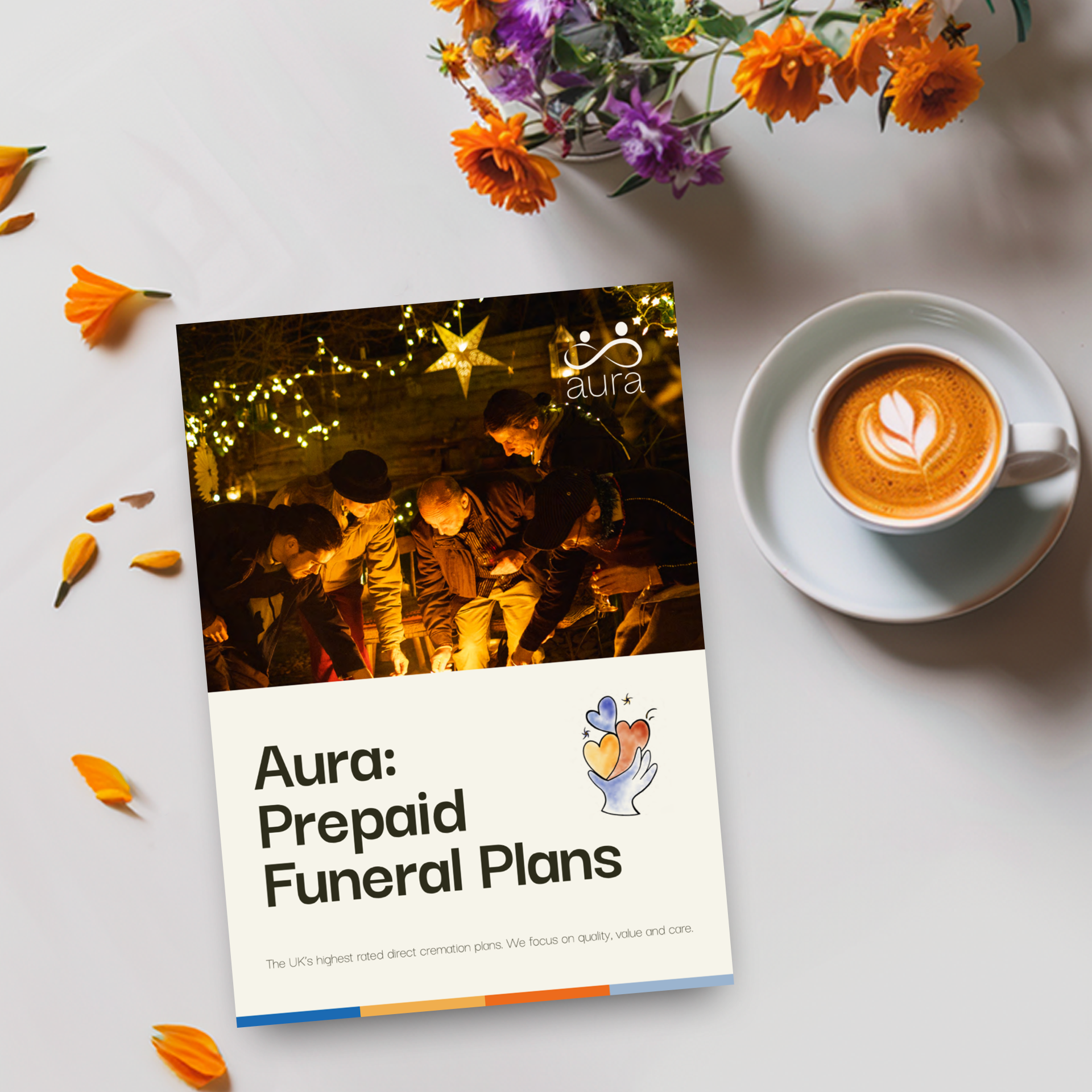
If you’d like to know more about how to plan a cremation with Aura, our brochure is a helpful place to begin.
Our funeral plans are a helpful way to put everything in place for you or someone else.
When the time comes, our experienced team will be here to guide you through each step, offering support and advice whenever you need it.
To find out more about how our plans work, what’s included, and our story, you can request a brochure by clicking the link below. We will then send you a copy by email or First Class post—whichever you prefer.
The person arranging the funeral typically has possession and control. While cremated remains are not legally considered property, who has rights over ashes is determined by the cremation application and not inheritance law.
No. Ashes are not legally considered property, so they can’t be inherited in the same way as possessions or money. However, the will may express the person’s wishes, which should be honoured wherever possible.
If a disagreement arises, families should try to resolve it through discussion or mediation. If that fails, legal action may be taken via the Chancery Division of the High Court, which can make a final ruling. This is why advance planning is so valuable.
Disputes over ashes are increasingly common. Can you take someone to court for ashes? Yes—if an agreement cannot be reached, families can escalate the matter to the High Court under Section 116 of the Senior Courts Act 1981.
Yes. Ashes can be respectfully divided, often to allow multiple relatives to keep or scatter a portion. However, this should be done thoughtfully and in line with the person’s known wishes if possible.
Only the individual named on the cremation paperwork—usually the applicant or their nominee—can collect the ashes. If using a funeral director, who can collect ashes from a funeral director follows the same rule: they will only release ashes to the named person or someone authorised in writing.
Yes — if you don’t own the land. When considering scattering ashes, it’s important to know the rules for scattering ashes UK. You need permission from the landowner. In public places, local councils may have guidelines. Over water, the Environment Agency provides best practices.
Ashes can be buried in cemeteries, natural burial sites, or private land with permission. Burying ashes on private property is allowed in the UK, provided you have the landowner’s consent. You should also follow environmental guidelines—typically ensuring 3 feet of earth above and below the ashes to prevent disturbance.
Burial should follow basic requirements (e.g. 3 feet of earth above the urn) to protect water sources and wildlife.
Yes, you can travel with ashes within the UK and internationally. For international travel, carry:
A copy of the death certificate
Cremation certificate
Photo ID
Airlines may require notice and specific containers (x-ray-friendly urns).
Yes, via specialist couriers. Ashes must be securely packed and accompanied by official documents. Not all couriers will accept ashes, so confirm in advance and prepare the appropriate certification.
Scattered ashes: Cannot be recovered.
Buried ashes: May be moved in exceptional cases with an Exhumation Licence (England & Wales) or court permission (Scotland). Approval is rare and typically only granted when a genuine error has occurred.
Ashes are not considered personal property under UK law. However, is it illegal to take someone’s ashes without consent or proper authority? Potentially, yes—especially if it leads to a dispute. Legal consequences may follow if someone takes ashes against the wishes of the person with lawful control.