×

Two Together: Save £100!Save £100 when you purchase two funeral plans together. Call us for more details.

Written by Emily Cross.
18 minute read

In a world that celebrates beginnings, we tend to look away from endings…but endings shape us just as much as beginnings. They linger in our memories and leave long-lasting impressions. The way we say goodbye matters, and it’s not just for the person we’ve lost, but for everyone left holding the absence.
One of the most common places we say goodbye is at a crematorium. But what is a crematorium exactly? It’s a dedicated space where cremation takes place—designed to offer peace, dignity, and a respectful environment for final farewells. Quiet, understated, often tucked behind trees or at the edge of town–they’re not what most people imagine. You may be asking questions as you’re preparing to say goodbye to a loved one, considering cremation for yourself in the future and trying to understand the process, or just satisfying a curiosity. But you may wonder, what does a crematorium look like? What actually happens inside? And if you’ve never been to one before, will it feel peaceful or clinical?
Whatever brought you here, you’re not alone. Talking about death and dying might not be something we do every day, but that doesn’t mean we don’t think about it. This article is here to walk you through what a crematorium looks like, what happens inside, and how these spaces are designed to offer dignity, peace, and even comfort. No matter your reason for reading, we hope this gives you the understanding and reassurance you’re looking for.
Key takeaways:
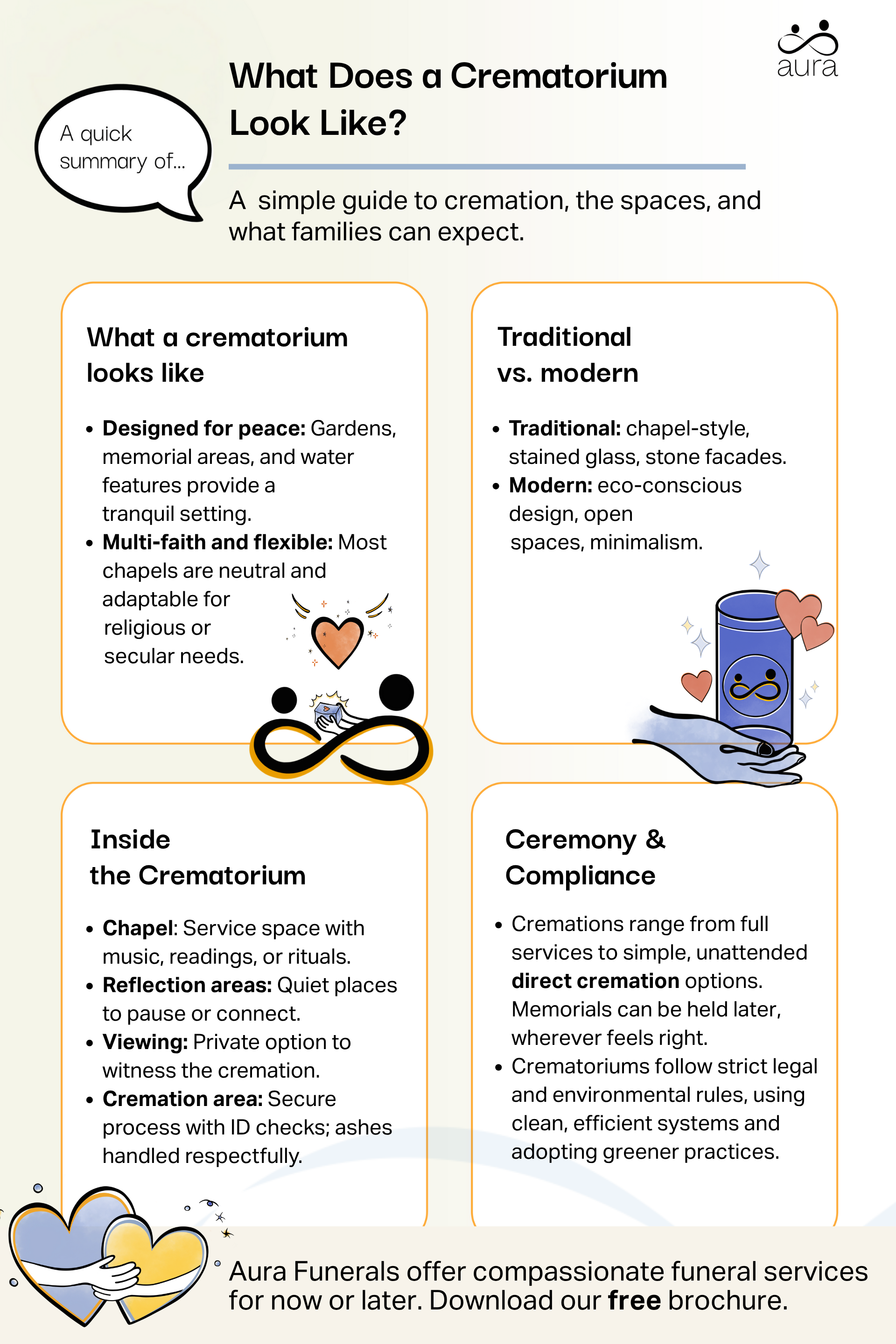
The history of cremations dates back thousands of years, with some of the earliest evidence found in ancient Europe around 3000 BCE. It was widely practiced by the Greeks and Romans, who saw fire as a purifying force, and was central to Hindu and Buddhist traditions, where it remains a sacred rite. In medieval Europe, cremation declined due to Christian burial customs, but it re-emerged in the 19th century with advances in technology and changing attitudes towards hygiene, space, and beliefs on death and funerals in religion. Today, cremation is the preferred choice for funerals in many parts of the world, valued for its simplicity, flexibility, and evolving environmental innovations.
The exterior and surroundings of crematoriums are designed to provide a peaceful and reflective environment for mourners. Many crematoriums are set within beautifully landscaped gardens, featuring a variety of flowers, shrubs, and trees to create a natural and calming atmosphere. Some also include dedicated memorial areas, such as remembrance walls, benches, or scattering gardens, where families can spend quiet moments reflecting on their loved ones. Water features like fountains, ponds, or small streams are common, adding to the tranquillity and offering a soothing space for contemplation.
Architecturally, crematoriums range from traditional stone chapels to modern designs that blend seamlessly with the natural surroundings, often incorporating large windows and natural materials. Many also provide secluded, private spaces where families can gather before or after a service. In recent years, there has been a growing focus on sustainability, with some crematoriums integrating eco-friendly elements such as wildflower meadows, solar panels, and woodland burial areas to promote environmental responsibility. These thoughtful design choices help create a comforting setting, making what can be a difficult experience feel a little more calming.
Older crematoriums, particularly those built in the 19th and early 20th centuries, often resemble small chapels or neoclassical buildings, with high ceilings, stained glass windows, and stone facades. Many crematoriums in the UK were built during the rise of cremation in the early 1900s and were designed to echo traditional places of worship, offering a familiar setting for funeral services.
Today, crematorium design has shifted toward minimalist, contemporary structures that prioritise light, space, and tranquillity. Instead of resembling churches, many new crematoriums have:
If you’re wondering what a crematorium looks like inside, here’s a closer look at the spaces you might encounter:
The chapel or service room : This is where cremation ceremonies take place. It might look like a small church or a more modern, neutral space. Not all crematoriums offer faith-based items in their chapels, but many do. Most modern crematoriums are designed to be multi-faith or non-denominational, providing a clean slate that can be personalised to suit different religious and cultural traditions.
Some may have crosses, prayer mats, or other religious symbols available upon request, while others keep the space minimal and allow families to bring their own items, such as candles, icons, or scriptures. If a specific faith-based setup is important, it’s always best to check with the crematorium in advance to see what they can accommodate. Families can choose music, readings, and other personal touches to go along with their preferences.
Waiting and reflection areas: These waiting areas are quiet spaces where visitors can sit before or after the service. These spaces often have soft lighting, comfortable seating, and neutral décor to create a peaceful atmosphere where visitors can gather their thoughts. Many crematoriums incorporate natural elements like plants, water features, or large windows overlooking gardens to provide a sense of tranquillity.
While some waiting areas are quiet lounges, others have designated rooms for more private reflection. Families may use these spaces to share memories, offer support to one another, or simply sit in silence. The goal is to create an environment that feels respectful and unhurried, allowing people to process their emotions in their own way.
Viewing rooms: In some crematoriums, families can witness the cremation process if they wish. Witnessing the cremation process can be an important part of grieving, closure, or religious observance. Some people find comfort in accompanying their loved one to the very end, ensuring that the cremation is carried out with respect and care. For others, it’s a deeply personal or cultural tradition—Hindu and Sikh families, for example, often prefer to witness the moment the coffin enters the cremation chamber as part of their farewell rites.
The setup varies by crematorium, but viewing rooms are typically quiet, private spaces with a large window or a screen that allows families to see the coffin being placed into the cremation chamber. In some cases, a curtain may be drawn at a certain point, depending on personal preference. Staff are present in the crematory to guide the process, offering reassurance and support. While not everyone chooses to witness a cremation, for those who do, it can bring a powerful sense of closure.
The cremation area: This area is not usually open to the public. It is where the cremation itself happens, carried out with compassion.
It houses cremation chambers (retorts): high-temperature furnaces designed for the dignified handling of remains. Managed by trained staff, this area operates under strict regulations to be sure each cremation is conducted properly. Though functional in purpose, this space is treated with the utmost sensitivity, recognising the significance of each person’s final journey.

The cremation chamber, or the retort, is where the actual cremation takes place. It’s a high-temperature furnace lined with heat-resistant bricks, designed to break down the body safely and efficiently.
Modern cremation chambers are carefully regulated to maintain a respectful process while managing emissions and environmental impact. The chamber usually operates at temperatures of around 800–1000°C, reducing the body to ashes and bone fragments.
One of the most common questions families have is how long cremation takes, and the answer varies slightly by facility, but generally falls between 90 minutes and three hours.
Once the cremation is complete, what remains are mostly bone fragments. These fragments are left to cool before being carefully removed from the cremation chamber using a metal rake or similar tool. Any non-organic materials, such as metal from medical implants or coffin fittings, are separated and recycled where possible.
The remaining bone fragments are then placed into a cremulator, a specialised machine that processes them into a fine, sand-like ash. This results in a smooth and uniform consistency before the ashes are placed in an urn or temporary container and returned to the family. Throughout this process, strict identification procedures are followed to guarantee each family receives only their loved one’s ashes. Families might choose to:
Attending a cremation ceremony can feel intimidating, especially if you’re unsure about what to expect. Whether it’s a small, intimate funeral or a larger gathering filled with shared memories, this moment is about honouring a life in a way that feels fitting.
Every cremation ceremony is different, and there is no right or wrong way to say goodbye, only what feels meaningful to those left behind. Some choose to put their wishes down in their advance care plans, their wills, or a prepaid funeral plan. This way, family members know exactly what their loved one wanted for their ceremony, or if they wanted a ceremony at all.
A cremation ceremony can be as private and humble or as open and grand as a family prefers, whether rooted in tradition or reflecting a more modern approach.
Different faiths and cultures have unique ways of marking the occasion. For example:
The crematorium staff and your funeral director (unless you’re planning your own funeral) will usually work with families to help them plan a ceremony that feels right.
For those who prefer simplicity, direct cremation is an option, and they happen in the same facilities as traditional cremations. This is a cremation usually without a formal ceremony, hearses, pallbearers, and no attendees. They offer a practical and cost-effective choice for those who don’t want a traditional funeral. Many families who choose direct cremation hold a memorial service or celebration of life later in a setting of their choosing, allowing for a more personal and flexible tribute.
If you’re considering planning ahead but aren’t sure where to start, you might be asking yourself what is a funeral plan? In simple terms, it’s a way to arrange and pay for your funeral in advance, often locking in today’s prices and removing the burden from your family. Aura offers all-inclusive direct cremation funeral plans across mainland Britain, designed to keep things simple, affordable, and clear.
Whether you prefer a personalised ceremony with loved ones present or a direct cremation without a gathering, Aura’s industry-leading funeral planning experts, the Aura Angels, see to it that every service is handled with care, empathy, and respect.
Cremation is a carefully regulated process designed to protect both the dignity of the person who has died and the rights of their loved ones. From strict identification procedures to environmental guidelines, every step is governed by laws that ensure cremations are carried out ethically and respectfully.
Whether you’re arranging a cremation or simply curious about how it all works, understanding the legal side can provide peace of mind.
These strict legal guidelines to operate safely and ethically. These include:
Every step of the cremation process is carefully tracked to make sure that the ashes are returned to the right family. This includes:
These steps help maintain transparency and trust in the cremation process.
Modern crematoriums follow strict environmental regulations to manage emissions and reduce their impact on air quality. Cremation produces gases and particulates, including carbon dioxide and trace metals from medical implants or coffin materials. To minimise this, crematoriums use advanced filtration systems, such as mercury abatement technology, to capture pollutants before they are released into the atmosphere.
Regulations in the UK, such as those set by the Environmental Protection Act, require crematoriums to monitor and limit emissions. Many newer facilities use energy-efficient cremators that burn cleaner and consume less fuel, reducing their carbon footprint. Some also offer eco-friendly alternatives, like electric cremators, and even more traditional cremation alternatives like alkaline hydrolysis are on the horizon as greener options for the future.
As awareness grows around environmental impact, crematoriums continue to adopt sustainable practices, ensuring that cremation remains a respectful yet responsible choice.
Some crematoriums provide educational videos about the cremation process to help families understand what cremation looks like—reassuring those who are unsure about the steps involved. These are made to be sensitive and focus on the technical side rather than showing anything distressing. While actual cremation footage is rarely made public, some documentaries and funeral industry professionals offer informational content about cremation procedures.
To help families feel more prepared, some crematoriums offer virtual tours or online walkthroughs of their facilities. These tours show the chapel, gardens, and other areas of the crematory, offering reassurance about the space before visiting. If you’re nervous about attending a cremation, checking if a crematorium has an online tour might help ease your mind.
Crematoriums are places of quiet reflection, dignity, and respect, designed to offer a peaceful and reflective setting. For many, they are not just facilities but spaces where love, memories, and emotions come together in a final goodbye. Whether you’re attending a cremation, considering cremation for yourself in the future, or simply curious about what happens inside, we hope that this article about what a crematorium looks like can help ease uncertainties and bring comfort in a time of loss.
At Aura, we believe that every farewell should be handled with the utmost care. That’s why we work with a network of carefully selected crematoriums across mainland Britain, ensuring that each cremation takes place in a well-maintained, respectful environment that upholds the highest standards.
Planning ahead can also provide reassurance, which is why Aura’s prepaid direct cremation plans allow people to make their wishes clear, reducing pressures on their loved ones when the time comes. No matter the choice, our goal is to offer a service that is simple, dignified, and tailored to what feels right for each family.

If you’d like to know more about how to plan a cremation with Aura, our brochure is a helpful place to begin.
Our funeral plans are a helpful way to put everything in place for you or someone else.
When the time comes, our experienced team will be here to guide you through each step, offering support and advice whenever you need it.
To find out more about how our plans work, what’s included, and our story, you can request a brochure by clicking the link below. We will then send you a copy by email or First Class post—whichever you prefer.
Crematoriums are often peaceful, landscaped spaces with gardens, trees, and memorial areas. Architecturally, they range from traditional chapel-like buildings to modern, minimalist designs that prioritise light, space, and sustainability. Many include features like water fountains, remembrance walls, and eco-conscious elements like solar panels.
Inside a crematorium, you’ll typically find:
A chapel or service room for funeral ceremonies
Waiting and reflection areas for quiet contemplation
Optional viewing rooms for those wishing to witness the cremation
A cremation area (not open to the public), where the cremation is carried out in a high-temperature chamber
Yes, many crematoriums allow families to witness the moment the coffin enters the cremation chamber, especially for cultural or religious reasons (such as Hindu or Sikh traditions). It’s usually done through a private viewing room, and staff are present to guide you through the process.
A cremation ceremony can be religious, secular, formal, or relaxed — it’s personalised to the family’s wishes. Ceremonies may include readings, music, eulogies, and symbolic gestures. You don’t need to follow a set formula; the most meaningful ceremonies reflect the life and values of the person who has died.
During cremation, the body is exposed to extremely high heat — typically between 1000 and 1300°C — for one to three hours. This process reduces the body to bone fragments, which are then carefully processed into a fine ash.
Soft tissues and organs do not survive the cremation process. Most of what remains are small fragments of bone, along with traces of the cremation coffin. Any metal — like coffin handles or surgical implants — is either removed before cremation or carefully extracted afterwards using magnets.
So while it’s natural to wonder if certain body parts are left behind, the truth is that nothing recognisably human remains. The final ashes are clean, safe to handle, and made up entirely of sterile bone particles and remnants of the coffin.
Direct cremation is a simplified cremation without a service, procession, or attendees. It’s a low-cost, dignified option where the cremation happens quietly, and the ashes are returned to the family. Many people who choose this later hold a separate memorial or celebration of life.
After cremation:
Bone fragments are cooled and processed into a fine ash (via a cremulator)
Ashes are returned in an urn or temporary container
Families may choose to keep, scatter, bury, or place the cremated remains in a columbarium. Strict ID protocols are followed throughout to ensure the ashes returned are solely those of your loved one.
Yes, crematoriums must follow strict environmental regulations. Many use filtration systems to reduce emissions and are adopting green technologies like:
Mercury abatement filters
Energy-efficient cremators
Green roofs and solar panels
Some facilities also support natural burials or offer biodegradable urns.
Some crematoriums now offer virtual tours or video walk-throughs to help families feel more prepared. These tours show the chapel, gardens, and other areas, offering reassurance about the space before visiting.
The cremation itself usually lasts between 90 minutes to 3 hours. Additional time is needed for cooling, processing the ashes, and following identification protocols.
Yes. Cremation is a highly regulated process in the UK, covering:
Licensing and regular inspection of crematoriums
Medical and legal paperwork before cremation
Environmental controls and emission monitoring
Chain-of-custody and ID tagging to avoid any mix-up