×

Two Together: Save £100!Save £100 when you purchase two funeral plans together. Call us for more details.


Written by Adam McIlroy.
13 minute read

The last thing we feel like doing if we have just recently suffered a bereavement is complicated admin. Unfortunately, when someone dies, it generates a mountain of paperwork and other concerns. You may be asking yourself questions like “What happens to bank accounts after death?” or “Can I close a bank account without a will?”. In this article, we are going to answer this question, and more.
We’d also just like to take a moment to say that, if you’ve come here looking for answers to such questions, then you may be facing a difficult time. Aura is here to help. We are the UK’s top-rated ‘Cremation Services’ provider on Trustpilot, with 4.9/5 stars. We offer our funeral services to those seeking a direct cremation for a loved one in the short-term, or for themselves in the future through one of our prepaid funeral plans.
Key takeaways:
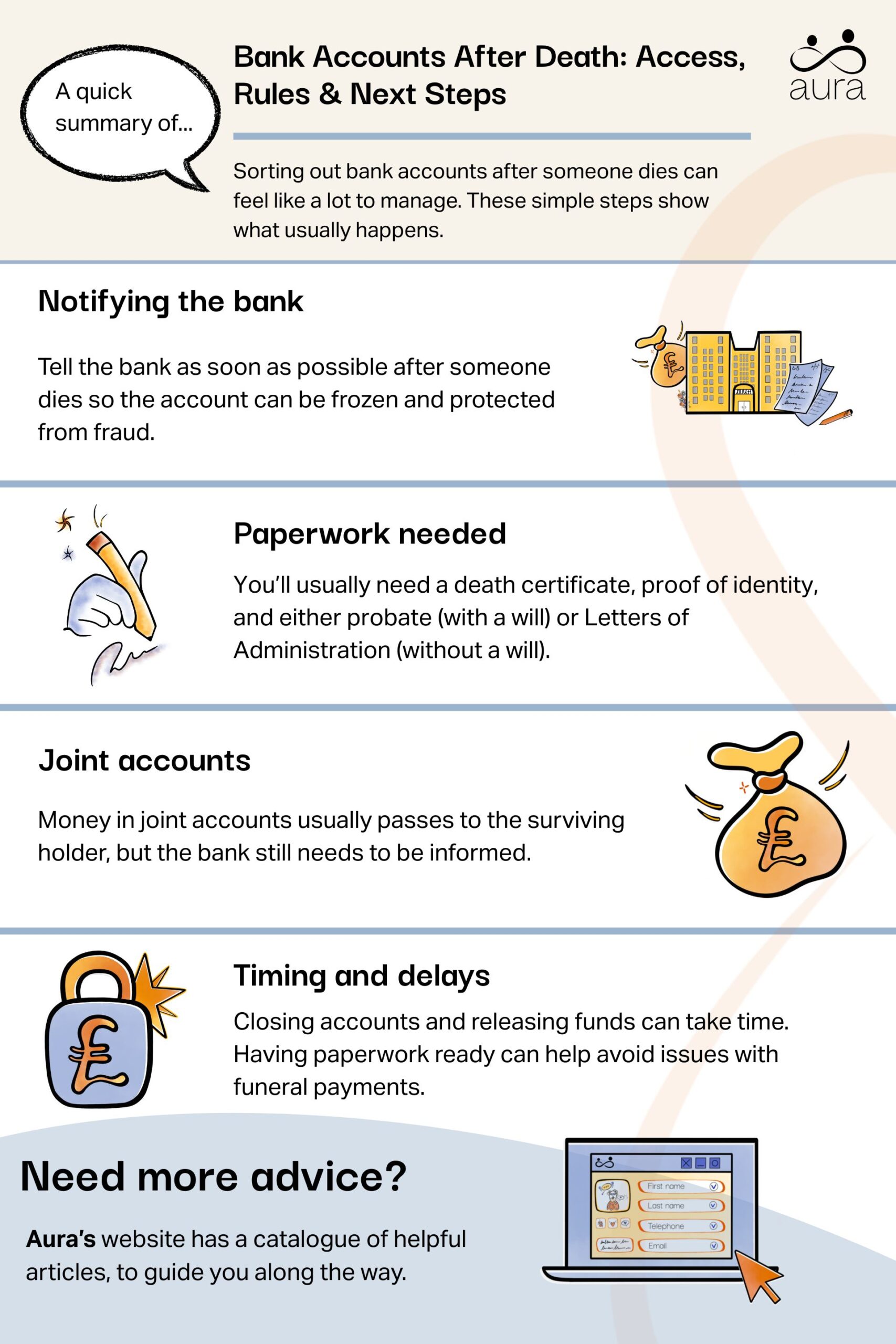
When someone dies, and we are their next of kin, we may have a responsibility to wind down all of their previously active financial affairs. This includes closing their bank accounts. This responsibility is especially important if we are the named executor of that person’s estate in their will. It’s important to contact the bank as soon as possible to notify them of their former client’s death, as they will need to block any future scheduled payments from needlessly clearing, and also protect any remaining funds from fraud.
Once you notify the bank, they will likely freeze the account immediately, before they go through some more elaborate steps with you which will lead to the account being closed permanently.
Each bank has a different procedure for handling queries relating to recently deceased customers; many have specific departments for this type of query. Today, banks are constantly trying to reduce the amount of administration and delays that result from dealing with them, so, with any luck, if you need to close a loved one’s bank account, their bank will make it easy for you.
You may or may not need to have applied for probate before the bank will entertain your request, but, it will depend on the bank itself. You will almost certainly already need to have registered the death. That’s because the bank will most likely ask you to provide a copy of the Death Certificate of the person who has died. It’s a very important legal document which officially certifies that a death has occurred, detailing the person’s cause of death, as well as other pieces of personal information, such as their name, age, and date of death.
You will also likely need to provide the bank with proof of who you are, and how you relate to their customer, just to confirm that you’re the right person to handle these matters.
In order to close the account of a loved one after death, you will likely need to move out any funds, and potentially settle any outstanding debts (although, if there is no money in the estate, the debt will not transfer onto the next of kin). If you are the executor of the estate, and there are debts on the account, depending on their significance, the bank may look to claim the cost of settling them out of any remaining value in the estate.
Conversely, if there are any funds remaining in the account, and the bank is satisfied as to the authenticity of the situation, they will begin the process of transferring any remaining funds to the next of kin. This is usually done with a simple bank transfer, once they’ve taken some details from you about where to send the money. This step is something that many families rely on in order to pay for the funeral of the person who has died, so it is important that it is done properly and quickly.
This raises the common question does next of kin have to pay for the funeral, which we address in our dedicated guide on next-of-kin responsibilities and funeral costs.
In general, the bank may need some or all of the following before being able to close the bank account, settle any debts, or transfer any remaining funds:
Once any remaining funds have been transferred, what happens next will depend on what is contained within the will. It will be up to the executor to administer the estate of their loved one properly, and in accordance with the wishes of the person who has died. The executor can collectively decide with other family members how much, if any, of the remaining estate can be used on paying for a funeral.

The matter of joint bank accounts is potentially simpler, especially if you yourself are one of the parties to the joint account. Any money or debt on the account is considered to be jointly owned by both parties to the account; if one of those parties dies, then full responsibility of the account will pass to the surviving holder. With that said, depending on the situation, the bank may simply allow the debt to die with the other party to the account.
However, it’s still important to notify the bank of a death, even if you are the other owner of the account. That’s because many banks will not allow the account to remain open if it is only owned by one person. In this situation, they may allow you to convert the account into a standard current account in your name, or they will simply have you close it, transferring any monies onwards to another account in your name, or having you settle any debts there from your own resources.
This solution of allowing you to simply keep any funds remaining whilst closing the account itself is a good compromise. It allows you to exercise your survivorship rights (your right to inherit fully the value of property which was co-owned and for which one of the owners has passed away) whilst at the same time allowing the bank to protect its obligations to remain a compliant and safe financial institution.
Closing a bank account without a will is potentially a little bit more complicated; if a bank asks you to supply proof that you’ve been granted probate (the right to execute the estate of someone who has died), you will not be able give it, as you can’t be granted probate unless you are the named executor in a will.
However, if your loved one has died ‘intestate’, that is to say, without a will, you will still be able to apply to oversee their estate. Instead of applying for probate, you will apply for something called a ‘Grant of Letters of Administration’. It will allow you the same rights over the estate of the person who has died as probate.
When we are trying to cope with the death of a parent, facing the prospect of dealing with their administrative affairs can be very hard. The only extra thing you might want to bear in mind with closing a parent’s bank account is that it can be especially important to keep a sure record of the assets that you find, including cash reserves in their account, or any investments or bonds they may have in association with their bank. If you are the executor of their estate, you will have to provide an official ‘final account’ of their assets for inheritance-tax purposes, so it will need to be precise and carefully done.
You don’t need to wait for probate to arrange a funeral. Most UK banks will release money from the person’s account to cover funeral costs, as long as you provide the death certificate and an invoice from the funeral director. The money is paid directly to the provider, not the family.
If the estate is complex or disputed, probate can take months, but that doesn’t always delay the funeral itself. In most cases, you can get things moving straight away, even if access to the rest of the estate takes longer. Some banks may take longer to process documents or respond during busy periods, but it’s rare for this to hold things up significantly, especially when Aura is handling the arrangements.
In order to head off delays as much as possible, it might be best to make sure you have all the paperwork the bank or relevant organisations may ask for ready in advance. You may want to start a funeral checklist to keep track of timeframes, documents you already have, and anything you still need to request.
If there isn’t a funeral plan or accessible funds in place, families sometimes cover the cost themselves and later reclaim it from the estate once probate is complete. However, most banks will release money directly to the funeral director when given the correct paperwork, so you usually won’t need to wait or pay entirely out of pocket.
We hope you have found this article useful, and that it has answered the question “What happens to bank accounts when you die?”. We know that the admin which relates to funeral arranging can be daunting, which is why we offer you our support. Our wonderful, compassionate Aura Angel team can act as your dedicated, personal funeral arrangers, giving you a cremation forms guide, someone well versed in funeral arranging, and able to offer you a caring ear if you’d simply like to talk about what you may be feeling. You can call us whenever you’re ready, and we’ll be able to help.


When a bank is informed that someone has died, the account is typically frozen to prevent further transactions and reduce the risk of fraud. It remains inactive until legal documentation is provided, such as a death certificate and probate or letters of administration.
Contact the bank’s bereavement or customer service team and inform them of the death. You will usually be asked to provide a copy of the death certificate, proof of your identity, and evidence of your relationship to the person who has died.
It depends on the bank and the size of the estate. Smaller accounts may be closed without probate, but most banks will ask for a grant of probate (if there’s a will) or letters of administration (if there isn’t).
Yes, most UK banks will release funds from the account of the person who died to cover funeral costs. You will need to provide a death certificate and the funeral invoice. The bank will typically pay the funeral provider directly.
If the account was jointly held, the funds usually transfer automatically to the surviving account holder. However, the bank must still be notified so they can update or close the account depending on their policy.
If the person died without a will, their estate is considered intestate. You will need to apply for letters of administration in order to manage the estate and access their bank accounts.
The timeline varies depending on how quickly documents are provided and whether probate or letters of administration are required. If everything is in order, it can take a few weeks, though delays may occur during busy periods.
Death certificate
Your ID and proof of relationship
Grant of probate or letters of administration
Account details for fund transfers
Funeral invoice if requesting funds for funeral expenses
Typically, the executor named in the will or the person granted letters of administration will handle bank notifications, close the accounts, and distribute any remaining funds as part of settling the estate.
Yes, but only if you are the executor of their estate or have been granted letters of administration. You will also need to provide documentation of your relationship and details of the parent’s account.
No, personal debts are not inherited. If the estate doesn’t have enough money to cover debts, they are usually written off. However, debts may be paid from any remaining estate assets before distribution.
To avoid delays, gather all necessary documents early and stay in regular contact with the bank’s bereavement team. If issues persist, consider asking your funeral director or solicitor to help liaise with the bank.
Notify each bank individually. If you are managing the estate, keep a list of all known accounts, and ensure you have the required documents for each. The executor must include these accounts in the final estate summary.
Create a simple checklist for:
Documents gathered
Institutions contacted
Tasks completed
Deadlines and follow-ups
This will help you stay organised during a difficult and often emotionally overwhelming time.