×

Two Together: Save £100!Save £100 when you purchase two funeral plans together. Call us for more details.


Written by Mitch Tapner.
9 minute read

Attending a funeral is a deeply personal way of honouring someone’s life, yet many people are unsure about their rights when it comes to being present.
In the UK, there are no fixed legal rules about who may attend, but decisions can be shaped by the type of service, whether it’s a traditional funeral, a direct cremation, or even a public health funeral.
Factors such as tradition and etiquette can also play a role, potentially influencing how families choose to include or limit attendance.
This guide explains funeral attendance rights in plain language, covering legal considerations, workplace policies, and the human side of arranging or attending a service.
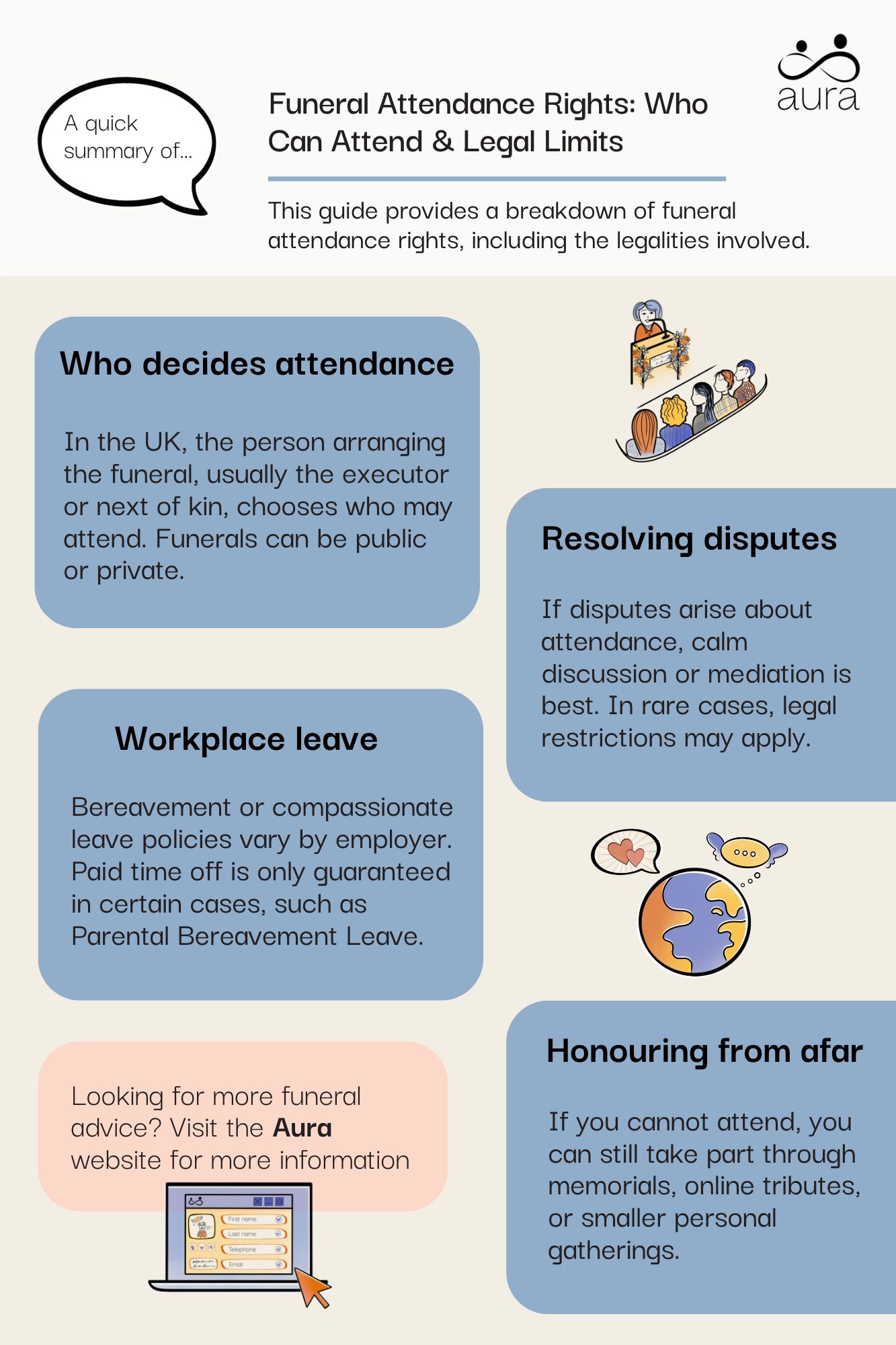
Funeral attendance rights describe both the legal and social ability to be present when someone is laid to rest. In the UK, there is no automatic legal right for the public to attend a funeral, it is usually a private occasion arranged by the person with legal responsibility of arranging the funeral, most often the executor of the will or the nearest next of kin.
Many funerals welcome extended family, friends, and members of the community. Others are private, with invitations sent only to certain people. These decisions can be shaped by cultural traditions, costs, venue capacity, or simply a wish to protect the emotional wellbeing of close family.
When thinking about what happens at a funeral, it’s worth remembering that arrangements are often made during a time of grief. Misunderstandings can arise quickly. Clear, kind communication, alongside an understanding of the law, can help to avoid unnecessary disputes.
In the UK, employees have the right to take time off to deal with an emergency involving a dependant, which can include the death of a partner, child, or parent. This time is usually unpaid unless an employment contract or workplace policy states otherwise. There is statutory paid leave in certain cases, such as Parental Bereavement Leave for the death of a child under 18.
Many people are unsure what type of leave you take for a funeral, in most cases, this falls under compassionate or bereavement leave, but the exact entitlement depends on your employer’s policy.
Most compassionate leave policies are set by individual employers. Larger organisations and public bodies often offer more generous terms than smaller companies. Making these policies easy to find helps reduce stress at a difficult time.
For those wondering how to plan a funeral, it’s considerate to share the date and time as early as possible, so attendees can arrange time off work without added worry.
To request leave, employees should let their manager or HR department know as soon as possible, ideally in writing. Include the date and location of the funeral, the relationship to the person who has died, and any travel needs.
Employers may ask for simple proof, such as an order of service or notice of death, although many will accept requests in good faith. Policies differ, the public sector may include compassionate leave in union agreements, while private employers may decide on a case-by-case basis.
Public funerals are generally open to anyone wishing to pay their respects. Private funerals, by contrast, may have a set guest list.
Families may choose privacy to avoid conflict, manage costs, or create a more intimate atmosphere, and in some cases this includes answering questions like can you attend a direct cremation or can you attend a public health funeral.
The person arranging the funeral, usually identified in the will or, if there is no will, the next of kin, has the legal authority to decide who may attend. Disputes sometimes arise, especially where family relationships have been strained. In these cases, the law generally supports the organiser’s decision.
Very occasionally, someone may be legally prevented from attending, for example through a restraining order or a court ruling. Mediation is often a gentler, faster way to resolve disagreements than going to court.
Yes, but only in certain situations. If the funeral is private, uninvited people have no legal right to attend. Services held in private venues may use trespass laws to ask someone to leave. If safety is a concern, organisers may request security or police presence.
Examples include:
In the UK, attendance is largely a matter for the family. In some European countries, cultural expectations lean towards more open funerals, while in others, including parts of Australia, funerals are treated as private family matters.
Bereavement leave also differs. France, for example, provides statutory paid leave for certain relatives, whereas UK law leaves most decisions to employers.
Traditions also differ widely. British funeral traditions and funeral etiquette can influence who is invited and how the day is conducted, from the tone of the service to expectations around dress and behaviour.
Attending a funeral abroad can involve extra steps: visas, travel arrangements, and different customs or legal rules. Employers may allow leave for travel, but it is not always paid. Where there are cross-border family disputes, legal advice can help prevent further difficulties.
Disagreements about attendance can be painful for everyone involved. Wherever possible, these should be resolved through open, respectful conversation before the funeral takes place. Sometimes, involving a neutral person, such as a mediator, religious leader, or community elder, can help.
Even informal written agreements can reduce the risk of misunderstanding. The aim is always to maintain dignity and respect for both the person who has died and those dealing with grief.
Employers can:
Funeral organisers can:
At Aura we know that questions about funeral attendance can feel overwhelming at times. We’re here to guide you through each step with kindness, clarity, and understanding.
We can help you plan a service that reflects the wishes of the person who has died. This might include guidance on invitations, ideas for making the day inclusive, and suggestions for personal touches.
If you’re thinking ahead, we can also talk you through creating a funeral plan*, giving you peace of mind that your preferences, from the style of service to who is invited, will be clearly set out and respected.
Whatever the situation, our focus is always on creating a farewell that feels meaningful, respectful, and true to the people it’s for.
*Terms and conditions apply. You will receive a funeral plan summary before purchase to help you decide if it meets your needs.


If you’d like to know more about how to plan a cremation with Aura, our brochure is a helpful place to begin.
Our funeral plans are a helpful way to put everything in place for you or someone else.
When the time comes, our experienced team will be here to guide you through each step, offering support and advice whenever you need it.
To find out more about how our plans work, what’s included, and our story, you can request a brochure by clicking the link below. We will then send you a copy by email or First Class post—whichever you prefer.
In the UK, the person arranging the funeral, usually the executor of the will or the closest next of kin, decides who can attend. Public funerals are open to anyone, while private funerals have a set guest list.
Yes, but only in certain situations. If a funeral is private, uninvited guests have no legal right to attend. In some cases, legal measures such as restraining orders or venue restrictions may also prevent attendance.
UK law allows employees to take time off for emergencies involving a dependant, which can include a death, but this is usually unpaid unless an employer’s policy states otherwise. Paid leave is only guaranteed in specific statutory situations, such as Parental Bereavement Leave.
If you are not invited, you might consider speaking privately with the organiser to understand their decision. Alternatively, you could pay your respects in other ways, such as sending a personal message, signing an online tribute, or attending a separate memorial gathering.