×

Plan ahead and save up to £200 Save up to £200 on selected funeral plans until 30 September. T&Cs apply. Click here for full details.

Two Together: Save £100!Save £100 when you purchase two funeral plans together. Call us for more details.

Written by Emily Cross.
20 minute read
Article reviewed by James Daley, Managing Director at Fairer Finance on October 31, 2025.
Planning a funeral is seldom an easy task, especially when you’re grieving. That grief might already be a heavy feeling, and having to think about costs can make a complex time even more confusing. When emotions are running high, unexpected expenses can add unnecessary stress, which may leave you feeling overwhelmed.
You might be reading this because you’ve just lost someone and are now facing the reality of making arrangements…we understand how difficult that can be, and hope this article can ease your mind and provide some answers. Whether you need to make arrangements now or are looking ahead, understanding how location affects funeral costs can help you make clearer, more confident decisions.
Average costs vary across the UK depending on where you are, with services in large cities often costing far more than those in smaller towns. Burial fees, cremation costs, and even transportation can all differ based on location. This article will walk you through these factors, helping you plan in a way that feels right for you.
Key takeaways:
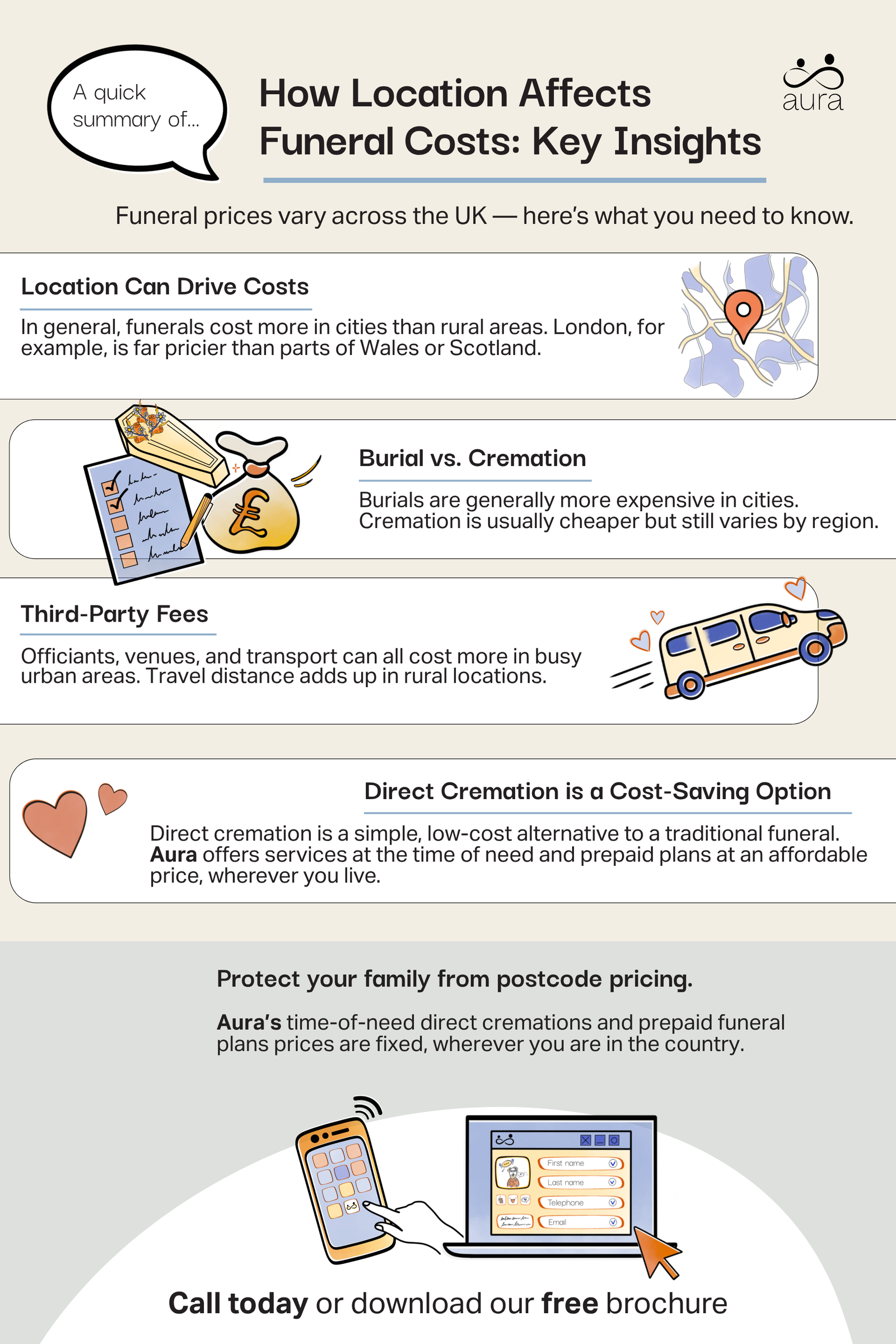
Location plays a bigger role in funeral arrangements than many people realise. How much funerals cost can vary depending on where the service is held, local customs, and the availability of funeral-related services. In the UK, urban areas might have higher funeral expenses overall compared to rural locations, but there are also regional differences in burial plot prices, cremation fees, and third-party costs. In areas where prices are significantly higher, families may be at greater risk of experiencing funeral poverty due to regional cost disparities.
This article explores these variables that affect funeral costs and provides insights into location-sensitive vs non-location sensitive prepaid funeral plans.
Understanding how location impacts funeral planning can help you make informed choices, whether you are arranging a service now or considering future plans. By being aware of these regional differences, it’s easier to arrange a service that meets both personal wishes and practical considerations.
Location plays a key role in funeral arrangements due to several factors:
Local market competition: In larger cities, a few major funeral companies often dominate pricing. This concentration can make it harder for families to find lower-cost, independent providers.
Corporate consolidation: The Competition and Markets Authority (CMA) investigation found that many small, family-run funeral directors have been bought out by large corporations. This has reduced competition in some regions and contributed to rising funeral costs.
Profit-driven pricing: As a result, profit-focused pricing models in urban markets have widened the cost gap between cities and smaller towns or rural areas. In many cases, the same type of funeral service can cost several hundred pounds more in densely populated regions simply due to market conditions.
Cultural and regional customs can also influence funeral costs. For example:
| Region | Average (Total) Funeral Cost (2025) |
|---|---|
| London | £6,499 |
| Scotland | £5,377 |
| North-West England | £5,371 |
| South-West England | £4,577 |
| Yorkshire | £4,653 |
The cost of burial vs cremation can vary depending on location, and understanding the different types of funerals and their costs can help families make clearer choices:
In addition to burial or cremation fees, third-party costs can influence the final funeral bill:
It’s worth doing a funeral home cost comparison, as prices for the same service can vary dramatically depending on location and provider.
With funeral costs rising in many parts of the UK, according to the SunLife Cost of Dying report, direct cremation has become an increasingly popular and affordable option. Often described as a no-fuss funeral, it takes place without a ceremony, giving families the freedom to hold a separate memorial in a location of their choice.
With Aura, there are several additional attended options when it comes to direct cremations: the intimate attended funeral and fully attended funeral are designed to suit the unique needs of families in the UK. Not only that, but wherever you are in the UK, our direct cremations cost the same, offering a consistent alternative to basic funeral options
Direct cremation takes care of all essential arrangements, including transportation, cremation, and the return of ashes, while keeping funeral costs significantly lower than the national average total cost of a funeral, which Sunlife puts at £5,140. We pride ourselves on delivering compassionate, professional care, ensuring every step is handled with empathy and understanding.
As touched on above, where a funeral takes place, whether in a city or a rural area, can have a big impact on cost, availability, and logistics. Urban areas typically have more funeral homes, crematoria, and service providers, but higher demand and limited burial space can drive up prices. In contrast, rural locations may offer more affordable burial plots and alternative funeral options, but families might face challenges such as fewer local providers and higher transportation costs. Accessibility is also a factor, as rural funerals may require longer travel times for mourners and funeral services. Weighing these differences can help you choose the right location for your needs while considering both practical and financial factors.
Something else to keep in mind is that the cost of having someone buried in a different place can be significantly higher, especially if they’re not a local resident. Many cemeteries apply non-resident fees, which may increase the burial cost.
The availability of funeral services varies between urban and rural areas – not just in cost and choice, but also accessibility – all of which can affect the final price.
When planning a service, you might go through your funeral preplanning checklist while considering both the cost and physical accessibility of the location to help ensure that loved ones are able to attend and participate comfortably. You might find it helpful to jot down a list of potential locations and make notes on what matters most to you—whether it’s cost, accessibility, or simply a place that feels right for your loved one.
When thinking about environmental concerns and the availability of space, consider the following:
Urban areas: Many UK cities have increasingly limited burial space, making plots ever-more expensive and difficult to secure. This, in part, has led to a rise in cremation, which remains the most common choice, as well as alternative options such as reusing old burial plots and natural memorials in green spaces.
Rural areas: With more land available, rural cemeteries and crematoria generally have lower burial and cremation costs and greater access to woodland and natural burial sites. Green burials use biodegradable materials and avoid embalming chemicals, and are therefore thought to be more kind to the planet. These green burials, or natural burials, are becoming more in demand, particularly in locations managed by conservation trusts. These types of funerals are also more affordable than traditional burial sites, according to Legal & General.
Coastal and flood-prone areas: Certain parts of the UK, especially in low-lying areas like Norfolk, Somerset, and parts of Wales, may have burial restrictions due to flooding risks and groundwater protection laws. Some cemeteries in coastal regions that face erosion concerns, may limit new burials or require additional planning.
When choosing a funeral location in the UK, it may be helpful to consider not just cost and accessibility, but also how local environmental and space factors might impact burial or cremation options.
Funeral costs can vary widely, especially depending on where in the UK the funeral takes place. The good news is, there are ways to reduce expenses while still ensuring a respectful and meaningful farewell:
Shop around locally: Comparing quotes from different funeral directors can make a real difference. The Competition and Markets Authority (CMA) found that families could save over £1,000 simply by shopping around.
Choose simpler services: In high-cost areas, selecting a basic funeral package, such as a direct cremation or intimate attended service, can save thousands without compromising on care or dignity.
Consider financial planning options: An over-50s life insurance policy can help cover or contribute to funeral expenses. While it may not cover everything, it can reduce the financial burden left behind.
Plan ahead: Preparing early and understanding how funeral prices vary in your area can help prevent unnecessary costs and emotional stress later on.
Aside from comparing prices and simplifying services as mentioned above, another way to protect against regional cost differences is to plan ahead.
With so much information to take in, planning a funeral can feel overwhelming, especially when grieving loved ones are left to make what can be difficult decisions under emotional and financial strain.
By purchasing a prepaid funeral plan for yourself, you can help ease this pressure by making the arrangements in advance, ensuring that everything is taken care of when the time comes. By securing funeral costs at today’s prices, prepaid plans help protect against rising expenses, wherever the location. They can also remove uncertainty, giving loved ones clear guidance on your wishes and outlining the type of service you want.
Having a plan in place means that, instead of worrying about logistics and costs, your family can focus on remembering and honouring your life. Aura’s prepaid funeral plans offer a simple and affordable way to arrange a service in advance, enabling your loved ones to focus on commemorating your life, not dealing with unexpected costs. No matter where you are in mainland Britain, our plans are priced the same, providing nationwide coverage without hidden fees or regional price differences.

Some pre-paid funeral plans have restrictions based on location. Important considerations include:
Flexibility in relocation
If you think you might move in the future, it’s important to choose a funeral plan that can adapt to a change in location. Things to look out for include:
When choosing a funeral plan based on location, you might consider asking:
Does the plan cover the area where I currently live and account for the typical funeral costs in that region?
What happens if I move to a different part of the UK?
Are there any extra charges for collections in rural or remote areas?
Is national coverage included, or is it limited to certain regions?
Will the plan provider still handle everything if I move closer to the time it’s needed?
Non-location specific prepaid nationwide funeral plans like those offered by Aura provide flexibility for those who may move in the future or want reassurance that their arrangements will be honoured anywhere in mainland Great Britain.
Unlike region-specific plans, which may be limited to certain areas, these plans cover services nationwide, ensuring that funeral costs and logistics remain manageable regardless of where the person dies. This can be especially beneficial for individuals who relocate for work, retirement, or to be closer to family.
By choosing a plan that isn’t tied to a single location, families can avoid unexpected fees and complications, providing greater peace of mind for both the planholder and their loved ones.
If you are weighing costs of a funeral in your area and are concerned about rising prices or changing locations, you might consider planning ahead with a prepaid funeral plan. This not only provides you with peace of mind, but can relieve those left behind from financial worries during what can be a difficult time.
Aura’s plans can help you take control of your end-of-life arrangements by helping you plan in advance, ensuring that the practical details of your funeral are taken care of, leaving your loved ones free to focus on celebrating your life. We are regulated by the Financial Conduct Authority (FCA), and our plans are protected by the Financial Services Compensation Scheme (FSCS). You can rest assured that, when you purchase a *prepaid funeral plan from Aura, your money is secure.
As you compare funeral plans, it may be helpful to consider what matters most to you, whether it’s affordability, flexibility, or making sure your final wishes are honoured with care and dignity. Whether it’s an intimate gathering or a straightforward direct service, our prepaid options allow you to create a meaningful experience tailored to your wants and needs.
*Terms and conditions apply. You will receive a funeral plan summary before purchase.
If you’d like to know more about how to plan a cremation with Aura, our brochure is a helpful place to begin.
Our funeral plans are a helpful way to put everything in place for you or someone else.
When the time comes, our experienced team will be here to guide you through each step, offering support and advice whenever you need it.
To find out more about how our plans work, what’s included, and our story, you can request a brochure by clicking the link below. We will then send you a copy by email or First Class post—whichever you prefer.
Martin Lewis, through his website MoneySavingExpert, does not directly recommend specific funeral plan providers. However, he does recognise that a good prepaid funeral plan can protect your family from rising costs and reduce stress during a difficult time—if the provider is reputable, regulated, and fairly priced. He advises comparing plans using independent ratings like those from Fairer Finance, which currently rates Aura’s plans with 5 stars. Martin also encourages consumers to read the small print and understand exactly what’s included and excluded.
Legally, the next of kin is not automatically responsible for funeral costs. Some pay using money from the estate of the person who has died. If there are no funds in the estate, the local council may step in to arrange a Public Health Funeral—but this is a very basic service. It’s why some families choose prepaid funeral plans, to remove any doubt or pressure later on.
If there is no money in the estate to cover the funeral, and no prepaid plan in place, the council may provide a simple cremation or burial, known as a Public Health Funeral. These are usually unattended and do not allow for personalisation or family input. If a family member has already agreed to make the arrangements, they may still be liable for the cost—even if they don’t have the funds. Some may be eligible for help from the Funeral Expenses Payment via the Department for Work and Pensions (DWP), but eligibility is strict.
Yes. Many people choose to pay for their funeral in advance by purchasing a prepaid funeral plan. This allows you to arrange and pay for key elements of the service at today’s prices, protecting you and your family from future price increases. Aura’s plans are available nationwide, regulated by the Financial Conduct Authority (FCA), and protected by the Financial Services Compensation Scheme (FSCS), giving you added peace of mind.
In the UK, you can scatter ashes on your own private land without permission. If you want to scatter them in a public place—such as a park, river, or beach—you’ll generally need permission from the landowner, council, or environmental authority. Many crematoriums also have dedicated gardens of remembrance, where ashes can be scattered respectfully. Be mindful of weather conditions, other people nearby, and whether you’d like the location to be visited again in future.
Yes. This is known as a direct cremation—a simple cremation without a ceremony or mourners present. It’s often chosen by people who want something low-key, affordable, or who prefer for loved ones to gather informally later. Aura offers both unattended and attended direct cremation services at a fixed, nationwide price, giving families a respectful yet practical option that meets modern needs.
Yes. A simple coffin is always included in the cremation process, whether it’s a traditional funeral or a direct cremation. With Aura’s direct cremation services, the cost of the coffin is already included in the fixed price. There is no need to purchase a separate one, and we ensure it meets all required standards for respectful handling and legal compliance.