×

Plan ahead and save up to £200 Save up to £200 on selected funeral plans until 30 September. T&Cs apply. Click here for full details.

Two Together: Save £100!Save £100 when you purchase two funeral plans together. Call us for more details.

Written by Emily Cross.
19 minute read

Article reviewed by Judy Carole, Published Author on May 9, 2025.
When it comes to planning a funeral, it can sometimes feel like a heavy and exhausting task to simply wrap your head around all of the different professionals and services available. Making decisions about what would be best for yourself or a loved one is important, and you may feel that there is a lot of pressure on your shoulders.
One of the funeral professionals you might choose to involve is a funeral celebrant, who officiates and leads the ceremony. In this article, we will delve into the role of a funeral celebrant, and why you might choose to hire one after someone has died, or consider one when making your own funeral preplanning checklist. We’ll also touch on who can conduct a funeral in the UK, and explain why celebrants are an increasingly popular option for those seeking something more personal or non-religious.
We want to acknowledge that, if you’ve been brought to this article because you’ve suddenly found yourself dealing with the unexpected death of a loved one, needing to know what to do when someone dies, or think you might need this information in the near future, we understand the difficulty of your situation. We are here to help, and we hope this article can be of use to you.
Key takeaways:

For instance, while a priest or pastor might follow a standard liturgical framework, a celebrant’s approach is adaptable. They can blend cultural elements, personal anecdotes, or unique rituals to craft a bespoke service. This difference often makes celebrants an ideal choice for families seeking a secular or tailored ceremony.
If you are planning your own funeral, it can be helpful to get specific about the different services and options you’d like incorporated into your service.
Preplanning your funeral can significantly reduce the anxiety your family will likely experience while grieving, as they’ll have the reassurance that all arrangements are already in place. Without the guesswork of trying to figure out what you’d have wanted, they can focus on honouring your memory, and on their own grief.
It also provides peace of mind for you, knowing that everything has been thoughtfully organised, such as stating that you’d prefer to have a celebrant officiate the ceremony instead of, for instance, a religious figure, such as a priest.
If you’d like help figuring out what to include in your own arrangements, our funeral arrangements checklist can guide you through each part of the planning process.
If you’re looking to alleviate some stress for your loved ones after your death, you might be interested in purchasing a prepaid funeral plan from Aura.
As the UK’s highest-rated provider of prepaid funeral plans*, Aura enables you to plan and pay for your funeral in advance, ensuring your family is supported and relieved of financial worries during an emotionally challenging time. Our plans give you the opportunity to organise your funeral in line with your personal preferences, assuring that your wishes are fulfilled.
When the time comes, our team of expert funeral arrangers, the Aura Angels, will be there to guide your family through every aspect of the arrangement, including booking a celebrant. Whether it’s handling paperwork or offering emotional support, we’ll be there to help as much or as little as needed.
Aura also partners with the Association of Independent Celebrants (AOIC), who are a network of professional celebrants with a range of specialisms. Your Aura Angel will work with the AOIC to find a suitable celebrant.
Choosing the right funeral plan is a very personal decision. When you’re comparing funeral plans, be sure to enquire about celebrant-related support if you know you’d like to include one in your service.
*UK’s highest-rated as the only prepaid direct cremation plan provider to have two five-star-rated plans by Fairer Finance, and the highest-rated national ‘Cremation Services’ provider on Trustpilot.
Because celebrants work closely with families, they are effective in helping to plan a ceremony that celebrates a person’s unique life. Celebrants must be sensitive and compassionate people, as the families they serve are often in the midst of grief. In order to create a service that is authentic and heartfelt, personal conversations must be navigated with care.
Talking about death and dying is not second nature to most people, especially with someone they’ve just met. However, a good celebrant will be an attentive listener, and will help family members to feel at ease sharing about their loved one and opening up. This process of gathering details for the service includes:
Meeting with the family in person, over the phone or online
Meeting to share details and stories about the person who has died is the first step in creating their service. It may take place in the family’s home or a more neutral venue such as a private corner of a cafe. These days, celebrants may meet families over video call or, more rarely, over the phone. In the meeting, they will go over:
Finalising the ceremony
After the initial meeting, the celebrant will work alongside other funeral professionals such as the funeral director and the funeral venue to make sure everything goes to plan. They will communicate with services such as printers for the orders of service and florists, if needed, and help organise the music and other tributes.
As the day approaches, the celebrant will remain in close contact with the family to ensure everyone feels comfortable with the plan, gather any last-minute materials needed for the ceremony, and to share their written pieces. They will ensure that everyone is content with the material and pleased with how their loved one is being represented, allowing ample time for any adjustments to the service and fostering an atmosphere of calm and confidence throughout the process.
On the day of the funeral, celebrants take on the responsibility of officiating, or performing the ceremony. Funeral celebrants are sometimes also referred to as funeral officiants, particularly in some non-UK contexts. This includes handing out the orders of service, delivering eulogies, readings, and tributes, as well as orchestrating moments for family and friends to participate. The celebrant sets the tone of the event, whether it’s solemn, uplifting, humorous, or a blend. Their objective is to have the service resonate emotionally with attendees and reflect the person’s values and personality.
Celebrants can officiate different types of services, including low-cost cremations. This is good news, as the prices of direct cremations is making these types of funerals a more popular option in the UK.
If you’re unsure whether a humanist or celebrant is the right fit for your needs, it may help to understand the key differences between the two. While both offer personalised, meaningful services, their approach to religion and spirituality differs — which can be an important factor depending on your beliefs or those of your family.
A civil celebrant designs and leads services for people who prefer not to have a religious ceremony or for those with beliefs on death and funerals in religion, who prefer not to hold their service in a religious venue, such as a church. They focus on balancing secular and spiritual elements, often intertwining religious ideas upon request such as sacred songs, poems or readings.
Humanist celebrants specialise in non-religious ceremonies, emphasising humanist values and perspectives and celebrating life without specific spiritual references. They create services which prioritise reflection on the life of the person who has died, and what they wanted to be remembered for. Due to the decline of religion in the UK, humanist celebrants are becoming an increasingly popular choice for families looking to incorporate a celebrant into a service.
Both types of celebrant put personalisation at the forefront, and work closely with families to achieve the perfect goodbye for their loved one.
A funeral director arranges the practical and logistical side of a funeral, while a funeral celebrant plans, writes and leads the ceremony itself. The funeral director takes care of arrangements such as transport, paperwork, and coordination with the crematorium or burial ground. The funeral celebrant focuses on creating a meaningful, personalised ceremony, often leading a celebrant-led ceremony that reflects the life of the person who has died.
These roles work closely together. The funeral director ensures everything runs smoothly behind the scenes, while the funeral celebrant supports the family in shaping and delivering a service that feels right. Good communication between them helps the day feel calm, organised and personal.
| Aspect | Funeral director | Funeral celebrant |
|---|---|---|
| Role / focus | Practical care and logistics | Ceremony planning and delivery |
| Typical responsibilities | Transport, paperwork, liaising with venues, scheduling | Writing the service, meeting the family, leading the ceremony |
| When you would hire them | Always, to arrange the funeral | When you want a personalised or celebrant-led ceremony |
| Cost (rough range) | Varies widely depending on services chosen | Typically £190–£250 |
| Religious vs non-religious flexibility | Can arrange both types of service | Can lead religious, spiritual or non-religious ceremonies |
In most cases, families work with both a funeral director and a funeral celebrant to create a service that is both well-organised and deeply personal.
Celebrants excel at crafting ceremonies tailored to individual preferences. Whether incorporating cultural traditions, cherished poems, or unique rituals, their services are designed to honour the deceased in meaningful ways.
For instance, families may request a celebrant to include a favourite piece of music or create a tribute based on hobbies, achievements, or milestones. This level of customisation helps make the service a genuine celebration of life.
For families seeking a secular or inclusive service, funeral celebrants offer a fitting alternative. They are skilled at blending spiritual, cultural, or personal elements to meet diverse needs, creating a ceremony that feels inclusive and respectful to all attendees.
This approach ensures that those from varying beliefs or backgrounds feel welcomed and valued during the service.
Selecting the right celebrant for your family is essential to achieving a fitting service. Consider these factors:
Meeting or having phone conversations with potential celebrants in advance of actually hiring them allows families to discuss expectations, and to attempt to forge a shared understanding of the ceremony’s tone and structure. You can arrange multiple meetings with different celebrants in order to make sure you’re selecting the right one to meet your needs.
The cost of a funeral celebrant in the UK typically ranges between £190 and £250. This fee generally covers:
Families should clarify inclusions to avoid surprises and to ensure the celebrant’s offerings meet their needs.
When considering celebrant-led services, it can also be useful to look at the wider picture of different types of funerals and their costs, since overall expenses will depend on whether you choose a direct cremation, an attended service, or a more traditional ceremony.

Funeral directors often collaborate with celebrants, coordinating the logistics of the funeral ceremony while the celebrant leads it on the day. Clear communication about preferences, such as ceremony themes or specific rituals, enables the process to run smoothly.
Discussing celebrant-led ceremonies early in the planning phase allows the director to suggest suitable candidates and manage scheduling effectively. At Aura, we have a network of celebrants with the AOIC, ready to call upon in the event that a family is interested in having a celebrant-led service.
You may not think that a celebrant would be an appropriate option for direct or low-cost funerals, such as a direct cremation.
While a direct cremation is normally unattended, Aura offers attended options, unlike many providers. Families can arrange a simple, low-cost service for a meaningful goodbye at a crematorium. Our team can help you to select a celebrant to oversee the service, and support you through all aspects of the arrangement.
Families who prefer to lead ceremonies themselves can still benefit from a celebrant’s expertise and input. Some celebrants offer guidance or pre-written scripts for DIY funerals, equipping families with tools to create meaningful services without professional officiation.
Some families choose to organise a celebration of life instead of a funeral, and celebrants can get involved in these types of gatherings, too.
Alternatively, families may explore community or cultural advisors to help shape the ceremony in a way that honours tradition and personal connection.
Whether you’re in need of immediate assistance for a loved one who has died, or are looking to protect your family from rising funeral costs in the future by purchasing a prepaid funeral plan, Aura is here to help.
We’re a family-run company, founded by Paul Jameson in 2019 after he was diagnosed with motor neurone disease. He set up Aura in order to make sure that families in the UK would benefit from his confrontation with his own mortality, and his experience with end-of-life planning. He runs the company today alongside his son, David (our CEO), and a family friend Ben (our COO). Aura’s mission is to provide a service that Paul would want for his own family.
Our highly-rated team of Aura Angels have decades of shared experience between them. It’s their passion to be there for you, and lead you by the hand through all the complexities of arranging a funeral with respect and compassion. If you have any questions, don’t hesitate to get in touch by calling or writing to us.
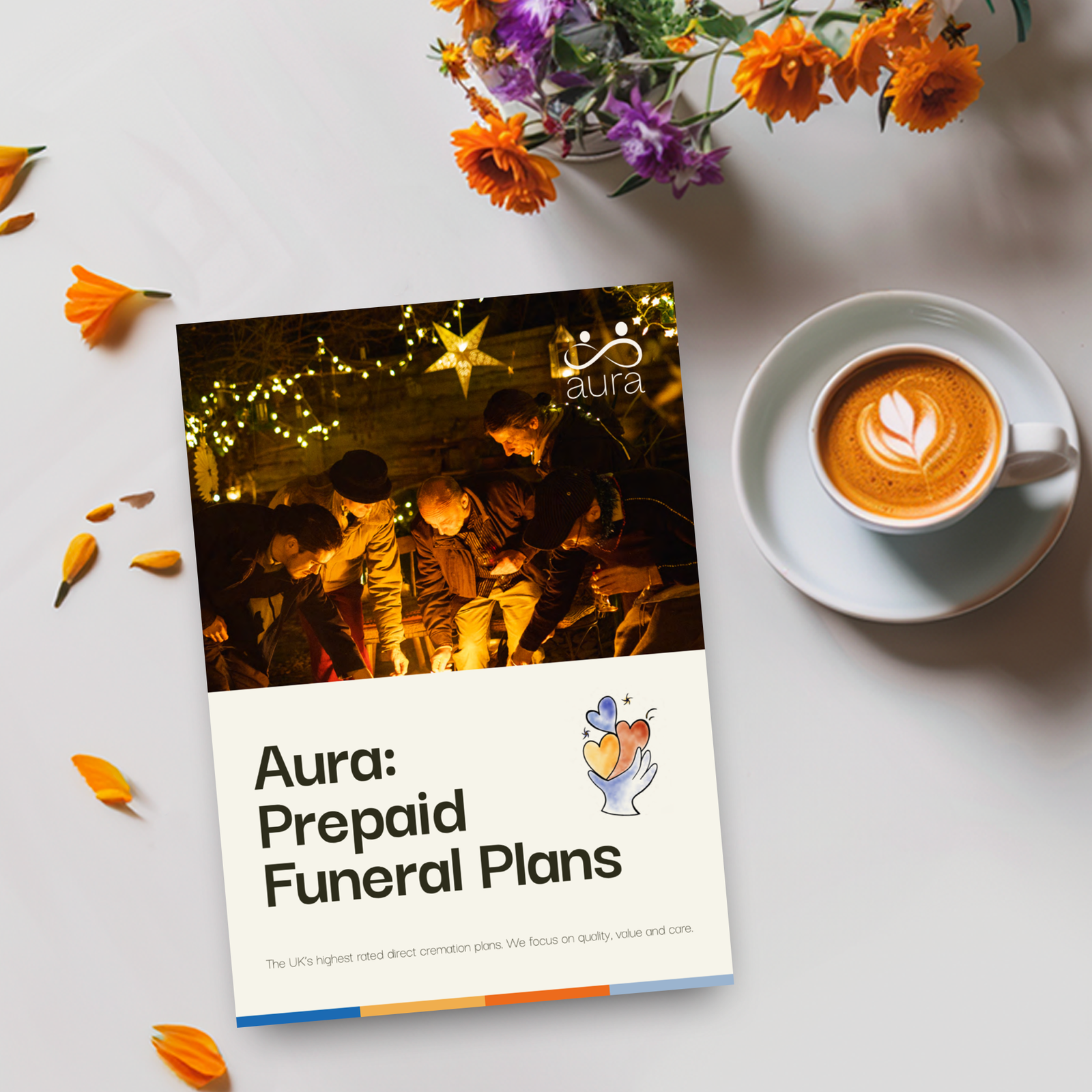
If you’d like to know more about how to plan a cremation with Aura, our brochure is a helpful place to begin.
Our funeral plans are a helpful way to put everything in place for you or someone else.
When the time comes, our experienced team will be here to guide you through each step, offering support and advice whenever you need it.
To find out more about how our plans work, what’s included, and our story, you can request a brochure by clicking the link below. We will then send you a copy by email or First Class post—whichever you prefer.
A funeral celebrant is a professional who designs and leads funeral services that reflect the life, personality, and beliefs of the person who has died. Unlike religious ministers, celebrants are not tied to a set script or faith. They create bespoke ceremonies that can be entirely non‑religious, partly spiritual, or simply focused on celebrating a person’s life.
Celebrants work closely with families to plan and deliver meaningful services. Their role includes:
Meeting with loved ones to learn about the person who has died
Writing and delivering eulogies or readings
Selecting music, poems, and tributes
Coordinating the order of service and overall tone of the ceremony
They act as both a guide and storyteller, helping families say goodbye in a way that feels authentic and personal.
There are two main types:
Civil celebrants – create flexible ceremonies that can include a mix of religious, spiritual, or cultural elements.
Humanist celebrants – focus entirely on non‑religious services that celebrate life without spiritual references.
Both aim to make the service inclusive, warm, and reflective of the person’s values.
A funeral celebrant can lead a range of ceremonies, including traditional funerals, celebrations of life, memorial services, scattering of ashes ceremonies, direct cremation follow-up services, and natural burial ceremonies.
In the UK, the average cost of hiring a funeral celebrant ranges between £190 and £250. This typically includes the initial consultation, ceremony writing, and officiating on the day. It’s worth confirming what’s included in advance to avoid unexpected fees.
Yes. Even with low‑cost or direct cremations, a celebrant can still be involved. Aura offers attended direct cremations where a celebrant can lead a short, simple service before or after the cremation, providing families with a personal and meaningful farewell.
Many families choose a celebrant because they prefer a personalised and flexible ceremony over a religious framework. A celebrant can honour traditions and beliefs without being restricted to one faith, making them a good choice for mixed‑belief families or those who want a modern, human‑centred farewell.
When selecting a celebrant, consider:
Experience – ask about their background and read testimonials.
Style – make sure their tone matches your family’s wishes (for example, calm, uplifting, or formal).
Connection – choose someone who makes you feel comfortable and understood.
At Aura, our Aura Angels work with the Association of Independent Celebrants (AOIC) to match families with trusted celebrants who suit their needs and values.
Your celebrant will talk with you about your loved one’s life, personality, and wishes. They’ll help decide the readings, music, tone, and structure of the service. They may also assist with practical details such as coordinating with florists, funeral directors, and printers for order‑of‑service booklets.
Yes. Families can conduct the service themselves if they wish. Some celebrants even offer DIY ceremony support, such as helping to write the script or suggesting readings, while allowing the family to officiate the event on the day.
There is no single required qualification to become a funeral celebrant in the UK. Many choose to train with organisations such as the AOIC, Civil Ceremonies, Humanists UK, or the Academy of Modern Celebrancy to develop their skills and approach.
Absolutely. Aura’s prepaid funeral plans allow you to specify that you’d like a celebrant to officiate your service. When the time comes, your assigned Aura Angel can, if you wish, arrange everything with a qualified celebrant, ensuring your ceremony aligns with your wishes and that your loved ones are fully supported.
No. Many celebrants also lead celebrations of life, memorials, and ashes‑scattering ceremonies. Their focus is always on helping people commemorate life and say goodbye in a meaningful and compassionate way.
It’s simple. When you contact Aura, your dedicated Aura Angel will talk you through your options and help you find a celebrant who fits your preferences. We handle all coordination with the AOIC network and ensure your ceremony—no matter how simple or elaborate—runs smoothly from start to finish.