×

Two Together: Save £100!Save £100 when you purchase two funeral plans together. Call us for more details.


Written by Adam McIlroy.
15 minute read

We soon learn how complicated the paperwork and documentation can be when we need to organise a funeral. Aside from the obvious pain of loss that we can feel, and the potential burden of the financial side of things, the admin of funeral arranging can cause a lot of stress and anxiety. “Do I need a Cremation Certificate or a Death Certificate?”, we might well ask ourselves, as well as many other questions. In this article, we are going to answer that question, as well as other interconnected questions concerning funeral paperwork and documentation.
If you’ve found us here, then it could well be the case that you yourself are currently organising a funeral for a loved one or someone close to you who has recently died. If so, we would just like to acknowledge the potential difficulty you are facing, and to let you know that we are here to help. Aura is the UK’s top-rated ‘Cremation Services’ provider on Trustpilot with a score of 4.9/5 stars, and we offer our funeral services to those requiring a direct cremation in the immediate future, as well as to those thinking about their own funeral, with a prepaid funeral plan, in many years to come.
Key takeaways:
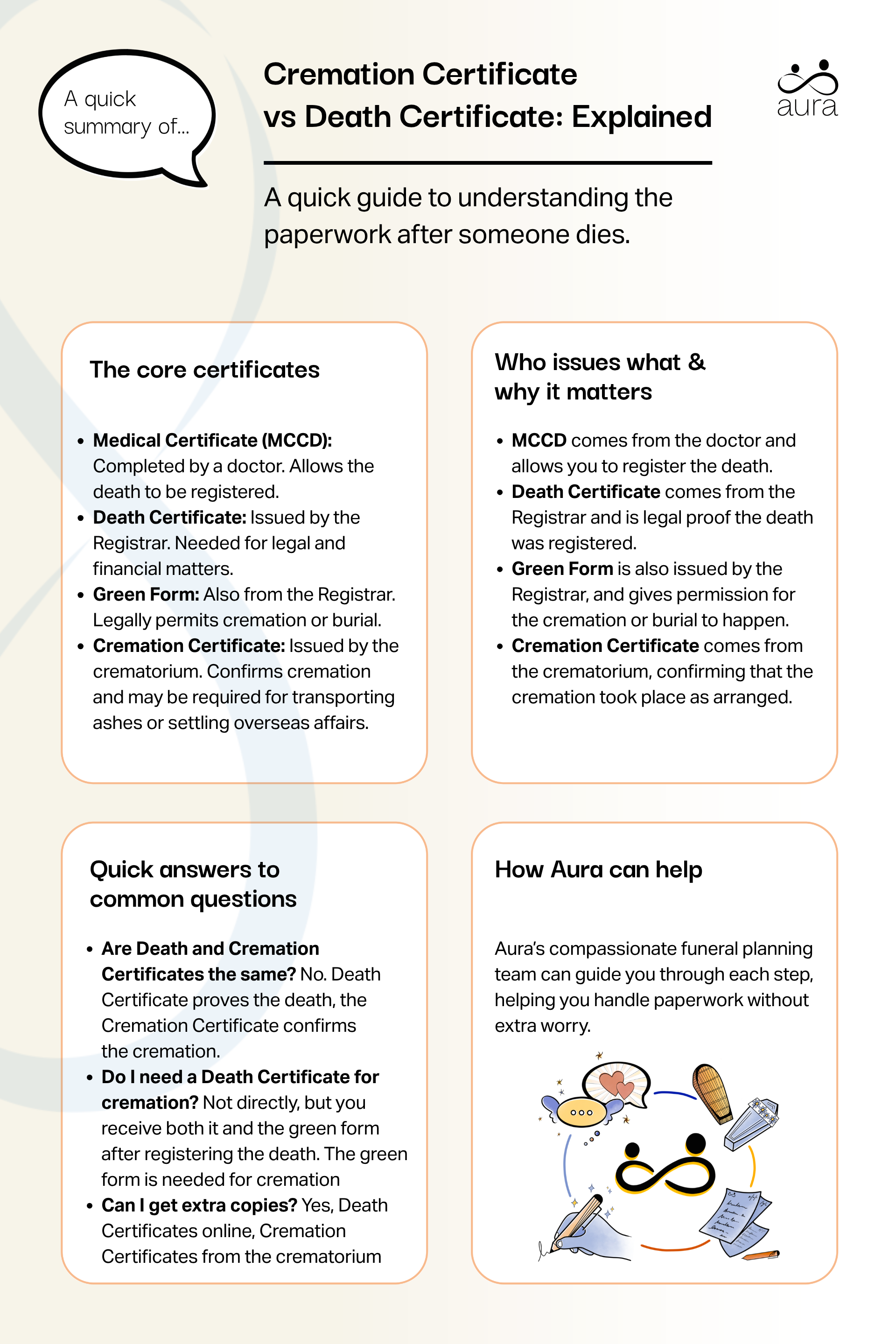
Among the different types of paperwork that exist concerning funerals, there is the ‘Green Form’ and the ‘Death Certificate’. They both serve different purposes.
If you’re wondering how to get a Death Certificate, you may also be wondering what it is in the first place. The Death Certificate is a document that you will receive from the local Registrar’s office as you meet with them to register the death of your loved one. It’s the legal proof that the death has been registered, and it explains their cause of death, as well as some other personal information about them.
It’s an important document for legal purposes, as it may not be possible to claim as a beneficiary under an over-50’s life insurance policy until they have seen the certificate. In some cases, you will need it before you can use any funds stored within the bank account of the person who has died, as their bank may require proof of their death before doing so.
A Cremation Certificate is a document provided by the crematorium to the next of kin after the cremation has taken place. This document is, essentially, a form of official confirmation that the person in question has been cremated as planned. It may also be referred to as a “certificate of disposition” or a “cremation permit”.
It should contain the following:
As well as giving the family a form of official peace of mind that the cremation took place as arranged, the document could be needed for certain purposes. For instance, if you are the executor of the person’s estate, and the estate has assets in a foreign country, they may need to see this certificate to prove that they have been properly cremated. You may also need it, depending on where you are travelling to, if you intend to transport their ashes to a foreign country with you.
There are certain pieces of documentation covering direct cremation, as well as other kinds of cremation.
A Death Certificate is not required per se in order to proceed with a cremation, but neither the Green Form nor the Death Certificate will be issued until you have registered the death. The Death Certificate lets you attend to legal matters, such as applying for probate if you are the executor of the will, or claiming under a life insurance policy, but it’s not strictly required by a funeral director or funeral facility in order for a funeral to go ahead. Whether you are weighing up cremation vs burial, you will receive a Death Certificate as part of the process, as registering the death is mandatory.
As an aside, the Medical Certificate of Death (MCCD) is yet another piece of paper which is separate to the Death Certificate and the Green Form, but which is issued around the same time. In fact, none of the others are able to be granted without the MCCD because it’s the MCCD which is first of all sent to the Registrar. This is what allows you to arrange an appointment to register the death in the first place.
There have been some changes to the death-registration process. Under the new rules, any doctor who cared for someone during their life can now complete the Medical Certificate of Cause of Death (MCCD)—even if they didn’t see them in the last 28 days. If they suggest a cause of death, it will still be checked by the Medical Examiner to make sure everything is in order. If there’s no doctor who knew the person, the Medical Examiner can take over and issue the certificate after reviewing the medical records carefully.
If the death is referred to a coroner—for example, if a post-mortem is needed—the coroner issues a separate form called Cremation Form 6. This takes the place of the Green Form. Separately, the next of kin or executor must complete Cremation Form 1 (called Form A in Scotland) to authorise the cremation. This application is usually passed to the funeral director to begin the cremation process.
It’s also worth knowing that UK law used to require two doctors to complete Forms 4 and 5 to confirm the cause of death. Now, only Form 4 is used. A medical referee at the crematorium reviews this and signs Form 10 before cremation can go ahead.
Before a crematorium or burial site will be willing to actively proceed with a funeral (i.e., to cremate or bury the body of your loved one), they will need to see a different certificate, issued by the Registrar at the same time as the Death Certificate. That other piece of documentation is called the ‘Certificate for Burial or Cremation’ (commonly referred to as the ‘Green Form’). It is the document that legally authorises the funeral to go ahead.
To be clear, it is possible to book certain services and to arrange certain elements of a funeral ahead of time, and it is often best not to delay where that’s concerned, but things won’t be able to move past a certain point until the Green Form is issued. The Registrar will often send the Green Form directly to the funeral director you have chosen on your behalf, or indeed, directly to the crematorium or burial site.
It can be tricky to keep track of all these pieces of paperwork, especially at a difficult time. Consider getting hold of a cremation forms guide in order to remain informed, and starting a funeral checklist to keep organised.
There is no fee for the Green Form—it’s provided free of charge by the Registrar. It must be given to your funeral director promptly so the cremation can go ahead without delay.
If you plan to hold the funeral or burial overseas, the Registrar will prepare different documents for you. The Green Form is not issued in these cases, so be sure to mention this during your registration appointment.

In order to obtain the Death Certificate of the person who has died, you will need to make an appointment to register the death at the local Registrar’s office (that is, in England and Wales, the office local to where the death occurred, not local to you if you live in a different part of the country). This can be done once the Medical Examiner has sent the MCCD to the Registrar detailing the cause of death. During your meeting with the Registrar, you will receive the Death Certificate, following some checks as to your identity from their side. They will then send the Green Form to the funeral director, or crematorium / burial site.
It’s possible to obtain copies of the Death Certificate, for instance, if various financial institutions need an official copy, or if other members of the family want a copy. This can be done on the UK government website and will cost you £12.50. Your certificate will be sent 4 days after you apply. It’s possible to pay £38.50 instead for access to a priority service, if you need the documents faster than that.
At the same time as issuing the Death Certificate, the Registrar may also give you a Certificate of Registration of Death (often called the ‘white form’). This is used to notify the Department for Work & Pensions (DWP) and other relevant government bodies. It’s a free form and can help stop pension payments or benefits automatically.
If you’re wondering how to get a copy of a cremation certificate in the UK, the crematorium will give you (if you are the next of kin) a certificate formally confirming its completion. It may be included with the hand-delivery of the ashes, or sent on separately. You can request copies of the certificate from the crematorium, but there may be an admin fee for this.
The Crematorium Certificate both formally confirms the conclusion of funeral-related matters between the crematorium and the family of the person who has died, and acts as another safe-guard confirming the identity of the person to whom the ashes belong.
It’s a good idea to store the cremation certificate in a safe place, such as a secure drawer, safe or digital archive. Avoid laminating it, as this can damage the paper or make it hard to use later.
There are some common questions about Cremation Certificates which people tend to ask.
No, a Death Certificate is not the same thing as a Cremation Certificate. A Death Certificate is a very important legal document issued by the local government (the Registrar’s office); it follows (and proves) the official registration of the death, and states the cause of death. It allows the executor of the will to apply for probate and can be essential for resolving the financial affairs of the person who has died.
A Cremation Certificate is a document issued by the crematorium which confirms the cremation has taken place as specified. It could be required should the estate of the person who has died have assets based outside of the UK, or for the legally compliant transit of the ashes outside of the UK.
A Cremation Certificate could be needed by the family when they are attempting to access and disburse assets of the person who has died which are based outside of the UK, depending on what the foreign government requires. It may also be required for legally compliant scattering and transport of the ashes outside of the UK into foreign countries. In some cases, this document will need to be notarised by legal professionals.
If you’re travelling with ashes—either within the UK or overseas—you’ll likely need the cremation certificate with you. Airlines, border agents, and foreign authorities often ask to see it. For international journeys, you might also need a burial transit permit.
When posting ashes, the container must be sealed, clearly marked “cremated remains,” and accompanied by the cremation certificate. Postal services often have specific rules about this.
We hope that this article has helped you to understand some of the funeral-related paperwork more clearly. If you currently find yourself planning the funeral of a loved one, or are interested in getting your own funeral plan together, we are here to talk to you. Our Aura Angels are the industry-leading, compassionate team who will be there to help you make all the arrangements. They can support you with paperwork, signpost you towards financial resources, and lend a caring ear if you’d like to talk about what you may be feeling.
If you’d like their support, they are ready for your call.


A Death Certificate is a legal document issued by the Registrar after a death is registered. It proves the person has died and includes the cause of death.
A Cremation Certificate is issued by the crematorium after the cremation has taken place, confirming the cremation details.
Not directly. But before a cremation can occur, the Medical Certificate of Cause of Death (MCCD) must be completed by a doctor and submitted to the Registrar. This allows you to register the death and receive the Green Form — the Certificate for Burial or Cremation — which is legally required for the cremation to proceed.
The Green Form (officially the Certificate for Burial or Cremation) is issued by the Registrar when the death is registered. It authorises the cremation or burial to go ahead and is sent directly to the funeral director or crematorium.
Once the MCCD has been submitted, you can register the death at the local Registrar’s office (in the area where the death occurred). The Death Certificate is given at this appointment. You can also order additional copies online for a fee (currently £12.50 per copy).
The crematorium provides the Cremation Certificate after the cremation has taken place. It may be delivered with the ashes or sent separately. If needed, extra copies can be requested from the crematorium (usually for a small admin fee).
Because the certificate can only be produced after the cremation, the timing depends on when the cremation occurs — but once it has taken place, the certificate is usually supplied immediately or within a few days, depending on the crematorium’s process and whether it’s sent by post.
You may need it:
No. Since ashes are not legally classified as property, they cannot be inherited in a will. However, the person arranging the funeral (typically the next of kin) usually has the right to the ashes and certificate.
The MCCD is a form completed by a doctor stating the cause of death. It is submitted to the Registrar to begin the process of death registration. Without it, you cannot obtain the Green Form or the Death Certificate.
Largely yes — both require:
A Medical Certificate of Cause of Death (MCCD)
Registration of the death
A Death Certificate
A Green Form
The Cremation Certificate, however, is specific to cremations and issued after the procedure.