×

Two Together: Save £100!Save £100 when you purchase two funeral plans together. Call us for more details.


Written by Mitch Tapner.
15 minute read

Article reviewed by Steven Barratt, Founder of Save Funeral Costs on August 14, 2025.
Funerals are an important part of saying goodbye, but for many people across the UK, they come with financial pressure. The rising cost of funerals means some families face real hardship when trying to arrange even the simplest service. This is known as funeral poverty – when someone cannot afford a funeral without falling into debt or monetary difficulties.
In this article, we explore what funeral poverty is, why it happens, who it affects, and what support is available. We also look at the emotional toll it takes on grieving families, and what can be done, as individuals and as a society, to help ensure everyone can have a dignified farewell, no matter their circumstances.
Key takeaways:
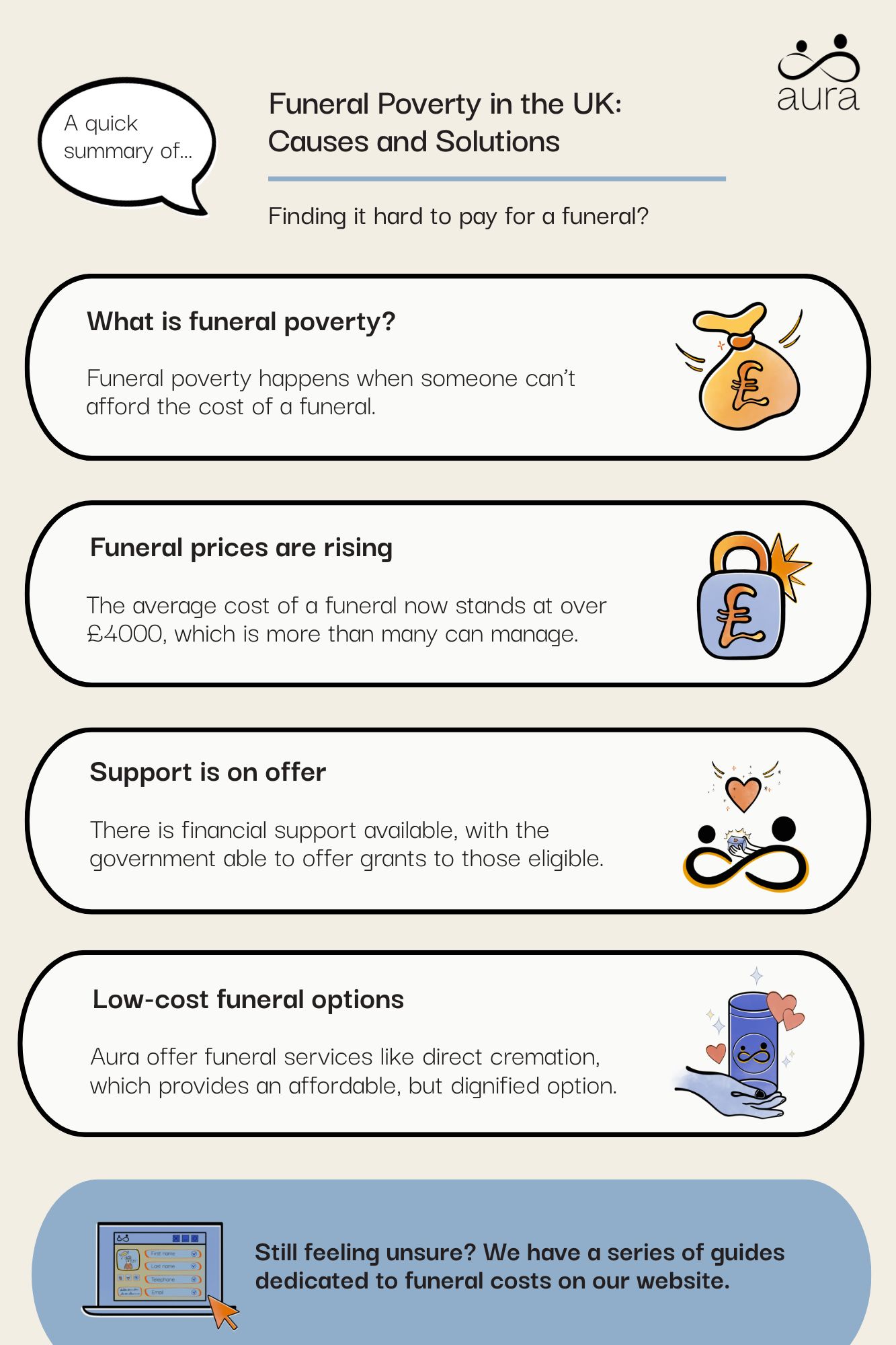
Funeral poverty happens when someone can’t afford the cost of a funeral without facing financial difficulty. It’s not just about money, it’s about the potential debt or monetary strain because of funeral costs. Sadly, this affects thousands of families across the UK every year.
The national average total cost of a funeral is now £5,140 according to SunLife, depending on where you live and the choices you make. For many people, especially those on low or fixed incomes, the average cost of a funeral isn’t affordable. This can lead to debt, emotional pressure, and fewer options when trying to honour someone’s life.
It’s not only about the price of the service itself. It also includes the wider impact of rising funeral costs across the UK, which have steadily increased over the past decade. As prices for burial plots, cremation fees, professional services and transport rise, many families find themselves struggling to meet costs during an already emotional time.
There are several reasons why funeral poverty has become more common in the UK:
Rising costs: Funeral prices have steadily gone up, often outpacing wages and inflation. Costs for cremation, burial, transport and professional services can add up quickly.
Low income and savings: Many families don’t have savings to cover a funeral. For those on pensions, benefits, or minimum wage, planning ahead for a funeral in the UK can be difficult.
Unexpected deaths: When someone dies suddenly or young, there may be no will, funeral plan, or savings. This leaves loved ones to manage everything.
Lack of access to credit or support: People with limited or poor credit history may struggle to get loans or short-term financial help.
Funeral poverty is not only about cost. It’s also about choice, dignity, and being able to grieve without added worry.
According to SunLife’s Cost of Dying Report, the national average total cost of a funeral is now £5,140. Research from Royal London and Quaker Social Action has shown that 1 in 8 people face financial difficulty when paying for a funeral.
Those most at risk include:
Even when support is available, it isn’t always enough or easy to access. Many families turn to loans, crowdfunding, or have to scale back the service.
In Scotland, the impact of funeral poverty is often felt more strongly in rural or lower-income areas. According to the Scottish Government, more rural communities could face extra transport and service challenges – showing how location can affect funeral costs.
Important points in Scotland:
Progress has been made, but many families still find it hard to pay for even a simple service.
Funeral costs are not the same everywhere. Prices can differ significantly depending on location, type of service, and local authority fees.
For example:
Burials are usually more expensive than cremations, largely because of the cost of purchasing and maintaining a burial plot.
Urban areas can sometimes have higher professional service costs, while rural areas may face additional transport fees.
Local council fees for cremation or burial vary across regions, which directly affects the total price.
These variations can make it difficult for families to estimate costs in advance, particularly if they have never arranged a funeral before.
Dealing with grief is difficult enough without worrying about money. But for many families, the pressure of funeral costs adds further emotional strain.
This can lead to:
The fear of not being able to afford a proper funeral can turn a time of remembrance into a time of anxiety.
When money is tight, learning how to keep funeral costs down could be hugely beneficial – here are some common compromises:
In some cases, a funeral may not happen at all, which can leave loved ones without closure.
If you’re thinking, “I can’t afford to pay for a funeral,” it’s important to know that you’re not alone, and there are options that may help. It’s often best to seek advice as early as possible, even before arrangements are finalised.
Many people ask, what happens if you can’t afford a funeral in the UK? In most cases, families explore government support, charitable help, or lower-cost funeral options. If you’re finding it hard to cover costs, there are ways in which you can get help with funeral expenses.
In England, Wales and Northern Ireland, you may be able to get a Funeral Expenses Payment if you’re receiving certain income-related benefits such as Universal Credit, Income Support or Jobseeker’s Allowance.
This payment can help with key costs like burial or cremation fees, and may offer up to £1,000 towards other expenses, such as a coffin, flowers, or travel, allowing families to pay for the funeral more easily. It’s paid by the Department for Work and Pensions (DWP). However, it’s usually given after the funeral has taken place, which means you may still need to pay upfront or borrow the money at first.
You might also be able to claim the Bereavement Support Payment. This isn’t just for funeral costs, but it can help ease the financial strain if you’ve lost a spouse or civil partner. To qualify, the person who died must have paid National Insurance for a certain amount of time, and the death must have happened within the past 21 months. You also need to be under State Pension age when you apply.
This support includes:
You can apply online, by phone, or by post. The rules can change and eligibility is quite specific, so it’s best to check the latest guidance at GOV.UK.
If you’d like more detail, our article on applying for a funeral grant explains the full process for both Funeral Expenses Payment and Bereavement Support Payment, including what you’ll need and how long it can take.
Even with this support, there’s often still a gap to fill. Some families borrow from friends or relatives, use a credit card, or reach out to charities. Others choose a direct cremation – a simpler option with no service, which is often much more affordable than a traditional funeral.
Aura is a family-run company aimed at helping families say goodbye in a way that’s both thoughtful and affordable. If you’re not sure where to start, we’re here to guide you – gently, without pressure, and always with care.
Several UK organisations are working to support families:
In Scotland, groups such as the Scottish Working Group on Funeral Poverty and Funeral Poverty Action Scotland are also leading change and offering help.
Reaching out to one of these organisations can be an important first step.

Tackling funeral poverty means more than helping people after the fact, it also means changing the systems behind it.
Campaigns making a difference include:
While more people are becoming aware of funeral poverty, lasting change needs continued attention.
To reduce funeral poverty in the long term, a number of practical solutions have been suggested:
While not every situation can be predicted, there are steps that may help reduce financial pressure in the future:
Planning ahead with a prepaid funeral plan or setting aside savings where possible
Discussing funeral wishes openly with family to avoid rushed decisions
Comparing providers and asking for clear, itemised price lists
Considering simpler funeral options, such as direct cremation
Seeking advice early if costs feel overwhelming
Making informed choices can provide both financial clarity and peace of mind.
At Aura, we know how hard it can be to arrange a funeral when money is tight, especially during a time of grief. That’s why we offer a simple, dignified direct cremation from just £1,195, with no hidden fees.
Our service includes everything needed for a respectful farewell, without a formal ceremony. Families can say goodbye in their own way, at their own pace.
You’ll be supported by our kind and knowledgeable team, known as Aura Angels, who are here to guide you through each step with care and clarity. There’s no pressure and no obligation, just honest help when you need it most.
If you’re not sure where to begin, we’re always here to talk.


Funeral poverty happens when someone can’t afford a funeral without going into debt or financial hardship. It often affects people on low incomes, those receiving benefits, older people on state pensions, and families without savings or funeral plans.
If you cannot afford a funeral, there are several possible options:
You may be eligible for a Funeral Expenses Payment (in England, Wales, and Northern Ireland) or a Funeral Support Payment (in Scotland) if you receive certain income-related benefits.
You may qualify for Bereavement Support Payment if you’ve lost a spouse or civil partner and meet eligibility rules.
Charities such as Quaker Social Action, Citizens Advice, and Turn2Us can provide practical guidance and support.
Some families choose a direct cremation, which is significantly more affordable than a traditional funeral.
Others may use crowdfunding, borrow from friends or family, or seek help from community organisations.
Even with government support, there can still be a financial gap to cover. That’s why low-cost funeral options and clearer pricing are increasingly important in helping families avoid debt during an already difficult time.
The national average total cost of a funeral is now £5,140. Costs can vary depending on where you live and the type of service you choose – cremation, burial, transport, and professional fees can all add up quickly.
Yes. In England, Wales and Northern Ireland, you may be able to get a Funeral Expenses Payment if you’re on certain benefits. In Scotland, the Funeral Support Payment offers slightly more generous and quicker support. Charities like Quaker Social Action, Citizens Advice, and Turn2Us can also help.
If you’re struggling, you could consider a direct cremation, which is a simpler and more affordable option. Some people hold memorials at home or crowdfund to cover costs. You can also get free advice from organisations that support families facing funeral poverty.
While the term “pauper’s funeral” is no longer commonly used, local councils in the UK still have a duty to arrange a funeral if no one is able or willing to pay for one. These are often referred to as public health funerals.
A public health funeral is a simple service arranged by the local authority. It ensures the person is laid to rest respectfully and legally, but without the additional elements of a traditional funeral, such as a large service, flowers, or limousines.
Family members may not always have control over the details, and the service is usually basic. However, it provides a dignified solution where no other options are available.
In most cases, the responsibility for arranging and paying for a funeral falls to the family — usually the next-of-kin or the person who chooses to organise it.
If the person who has died left money in their bank account, savings, or other assets, those funds can sometimes be used to pay for the funeral. In some cases, banks will release money directly to a funeral provider before probate is complete.
However, if there is no prepaid funeral plan, life insurance, or savings in place, the cost often falls to the family member arranging the funeral. This can create financial pressure, especially if the death was unexpected.
Funeral prices have risen faster than wages and inflation. Things like transport, burial space, and service fees all contribute to the cost. Campaigns across the UK are calling for fairer pricing, clearer information from funeral providers, and better financial products to help people plan ahead.