×

Two Together: Save £100!Save £100 when you purchase two funeral plans together. Call us for more details.


Written by Mitch Tapner.
11 minute read

When a loved one dies in hospital, it can be hard to know what happens next.
This guide explains what to expect from hospital mortuary procedures, step by step. From the moment death is confirmed to the point of release for funeral or cremation, each stage is handled with care, respect and professionalism.
Whether you’re facing this now or planning ahead with a funeral plan, understanding the process can offer some comfort and clarity during what can be a difficult time.
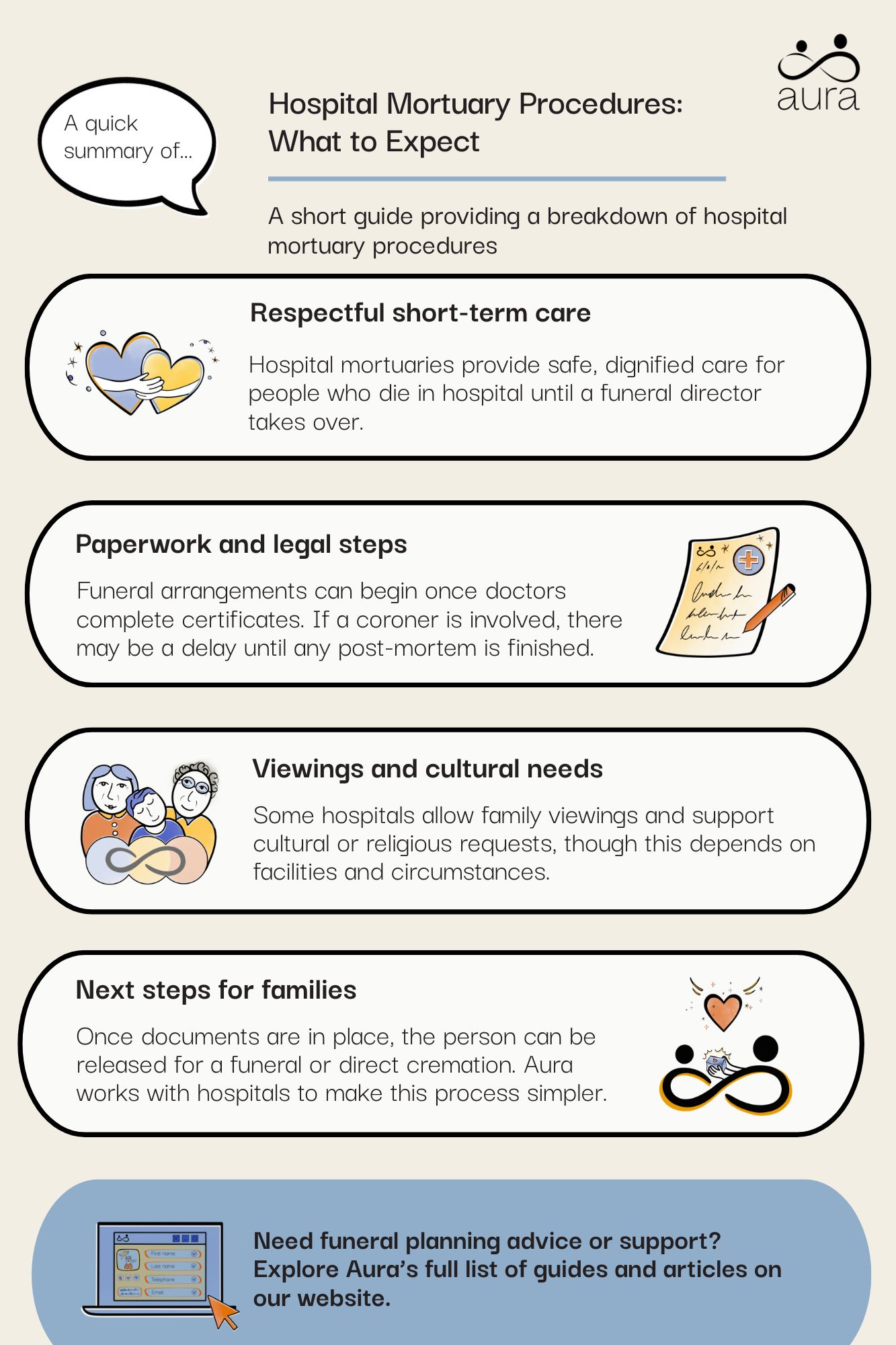
A hospital mortuary looks after someone who has died in hospital until they are collected by a funeral provider. The person who has died is cared for with compassion, in line with strict legal, ethical and medical standards.
These processes are in place to protect dignity, prevent mistakes and support both loved ones and staff. The word “mortuary” may sound clinical, but it’s a calm, well-managed space that plays an important role in what to do when someone dies.
Hospital mortuaries are secure, private environments, usually away from public areas. Their main role is short-term care of the person who has died, until the funeral director has been appointed and taken over their care.
They’re different from public mortuaries (which handle coroner cases) and funeral homes (which offer family-led services like viewings and embalming). A hospital mortuary’s role is to provide care for the person who has died in the immediate days after death has occurred.
All NHS hospitals follow national guidance, such as that from the Human Tissue Authority, alongside their own trust-level procedures.
Staff are trained in infection control, confidentiality and respectful handling. Everything from temperature checks to record-keeping is carefully monitored, helping ensure each person is treated with respect.
As soon as someone dies in hospital, staff follow a strict set of protocols. The person is respectfully transferred to the mortuary by trained staff, with identity checks carried out at each step using hospital documentation and wristbands.
Once in the mortuary, the person is formally registered, logged and cared for until a funeral director has been appointed to take over their care.
The next of kin is usually informed by a doctor or nurse soon after death. At the same time, staff begin recording key details, like the time and place of death, who was present, and the cause of death.
These records form the foundation for legal documents, including the Medical Certificate of Cause of Death.
In certain circumstances an unexpected death of a loved one may require a coroner to get involved.
Common reasons for a coroner’s investigation include:
A post-mortem may follow. If the coroner requests it, consent isn’t needed, but families will be kept informed. Once the post-mortem has been completed, funeral arrangements can continue to go ahead.
In some cases, an inquest may also be held to determine how and why the person died. Families often ask how long an inquest takes, it can vary depending on the complexity of the case, but it may take several weeks or even months to conclude. If the coroner begins an inquest, an interim death certificate is issued so that the family can continue to make funeral arrangements and deal with the estate.
Whether or not the death was expected, there are legal steps to follow before the person can be released for a funeral or direct cremation. These steps can affect how long it takes to arrange a funeral, especially if a coroner is involved or if documents are delayed.
If you’re dealing with a hospital death in the UK, the hospital’s bereavement office will usually guide you through the process. If you’re unsure what to do when someone dies abroad, the steps are different, but Aura can help point you in the right direction.
After someone dies, their case is referred to the Coroner or Medical Examiner for review. This is a standard part of the process and helps confirm the cause of death. Once the review is complete, a Medical Certificate of Cause of Death (MCCD) will be sent to the local registrar.
The Coroner or Medical Examiner will then let the family know when this has been done, so they can book an appointment to register the death.
There are two types of post-mortem (or autopsy):
Organ donation is a separate process. If the person who has died is eligible for organ donation and had not opted out, staff will still ask for the family’s consent before moving forward.
The person who has died is kept in a temperature-controlled unit within the mortuary. This short-term storage allows the person who has died to rest safely, whilst the funeral directors, mortuary staff, registry office and family complete the necessary paperwork and funeral planning.
Refrigeration helps preserve the body of the person who has died before collection. Embalming is not carried out at this stage.
So, how is the body prepared for cremation? In a hospital mortuary, preservation is done using refrigeration rather than embalming. The body is kept clean and handled gently, ready for viewing or collection by a funeral director.
If there are delays in arranging a funeral, it’s important to ensure continued cold storage. Some hospitals may ask families to appoint a funeral director quickly if space is limited.
There’s no fixed legal limit, but most NHS hospitals provide care and storage of the person who has died for up to 5–7 days at no cost. After that, a daily fee may apply if a funeral director is not appointed. It’s best to ask the hospital or bereavement office directly to avoid unexpected charges.
Some hospital mortuaries allow family members to view their loved one, though some restrictions may apply, for example, if the person had an infectious illness or if the hospital lacks viewing rooms.
Viewings need to be arranged with staff and may include a chaplain or religious figure if requested.
Once documents are in place, the person can be collected by a funeral provider. This is where Aura can help.
As a direct cremation provider, Aura coordinates everything from collection to cremation, and we can return the ashes by hand. We take care of the logistics so families don’t have to.
If everything is in order, this usually happens within 24–72 hours. Delays may be more likely if documents are missing or a coroner is involved.
The body can be moved:
Some people ask, can you take a body home from the hospital? It is possible in the UK, but it’s uncommon and must meet health and safety rules.
While NHS hospitals don’t charge for the first few days of mortuary care, fees may apply after that, especially in private hospitals.
So, how much does it cost to keep a body in the mortuary in the UK? Charges vary but may include:
Consider reaching out to the hospital’s bereavement office to get a clear picture of any costs.
Some funeral providers charge extra for body collection.
Aura keeps things simple, with clear, upfront pricing. Everything needed for a direct cremation is included, there are no hidden extras.
Behind the scenes, several professionals work together to support families and follow the correct procedures.
Good communication matters. Hospitals will typically keep families informed about:
Aura works directly with hospitals to help prevent delays and reduce stress for families, and keeps families up to date through every step.
Hospital procedures must be respectful as well as practical. Staff are trained to honour different cultural, religious and emotional needs.
Hospitals will try to support requests for:
Let staff know about any customs as early as possible.
Privacy matters, especially after death. Only authorised people can view or collect the person who has died, and staff follow clear guidelines to ensure care and respect at every step.
We understand how difficult it can be to make arrangements after someone dies in hospital. There’s a lot to process, and it can feel overwhelming knowing where to start, especially while dealing with grief.
Aura is here to guide you through each step, whether you’re arranging a funeral now or planning ahead with a funeral plan*. We work directly with hospitals to manage the collection, cremation, and safe return of ashes, so you don’t have to worry about the logistics.
Our direct cremation service is simple, dignified and affordable. You can speak to our team at any time for clear, compassionate guidance, with no pressure or obligation.
If you’re unsure what to do next, or just want to talk things through, we’re here when you need us.
*Terms and conditions apply. You will receive a full funeral plan summary before purchase.



When someone dies in hospital, staff confirm the death and move the person to the hospital mortuary. The next of kin is informed, and paperwork begins, including the medical certificate of cause of death. If a coroner is involved, this may delay the release for funeral or cremation, but the family will be kept updated throughout the process. Most hospitals have a bereavement office to guide families through the next steps.
The cremation itself usually takes between 1.5 to 3 hours. After that, the ashes are cooled, processed, and returned to the family. With Aura’s direct cremation service, the ashes are typically returned within 21 days of cremation if they are being hand-delivered, but they can be collected by the next of kin sooner than that.