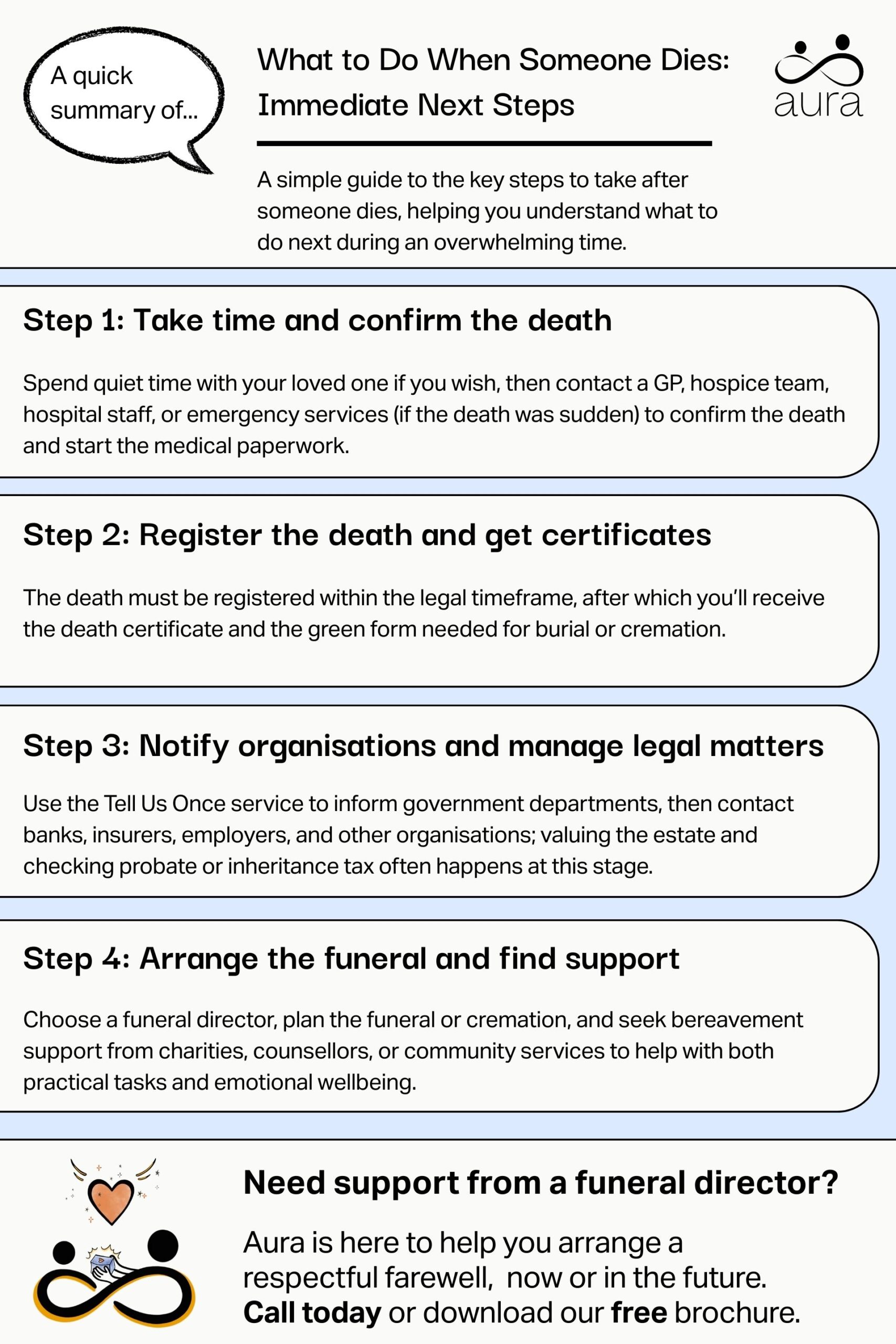
What to do when someone dies checklist
Getting a medical certificate
The Medical Certificate of Death (MCCD) is an official record and is required to enable you to register the death.
Following changes to the registration system in September 2024, the process has become more streamlined, with most documents now being shared directly between medical teams and the registrar.
After someone dies, a medical professional who cared for them will confirm the death and complete the MCCD, including the cause of death. This certificate is then reviewed by a medical examiner to check for accuracy before being sent straight to the local register office. Once the registrar has received it, they will either contact the next of kin or invite you to book an appointment to complete the registration.
Register the death
You must register the death within five days of the person passing away in England and Wales (eight days in Scotland). This is done at the registry office in the area where the person passed away.
After someone dies, a medical professional who cared for them will confirm the death and complete the MCCD, including the cause of death. This certificate is then reviewed by a medical examiner to check for accuracy before being sent straight to the local register office. Once the registrar has received it, they will either contact the next of kin or invite you to book an appointment to complete the registration.
The Registrar will require the following information from you:
- Date and place of death.
- Full name and address of the person who has died (including maiden name if they had been married).
- Date and place of birth.
- Occupation.
- Name and address of their husband or wife, or civil partner.
- Your name, address and your relationship to the person who has died.
- Whether the person who has died was in receipt of a pension from public funds.
How to get a death certificate
Once the death is registered, the registrar will issue a Death Certificate. You can request multiple certified copies which are necessary for legal, financial, and insurance purposes. However, there is a fee for every copy.
The registrar will also provide you with a certificate for burial or cremation (i.e. the ‘Green Form’ or the GR021 in Northern Ireland). This form enables the funeral to go ahead. They may send this form directly to your chosen funeral director or hand it to you.
Tell organisations and government services about the death
The registrar’s office will also provide you with a unique ‘Tell Us Once’ reference number. This online service enables you to inform most government departments of the death with one form. This is not available in Northern Ireland, but there is a helpful guide on the NI Direct website. If this service is not in your area, you may need to inform the following government departments individually:
- Department for Work and Pensions (DWP Bereavement Service)
- HM Revenue & Customs (HMRC)
- National Insurance (NI) Contributions Office
- Child Benefit Office
- Tax Credit Office
- Passport Office
- Personal, Workplace and Armed Forces Pensions
- Local Council
- DVLA (if the person had a driving licence)
Below is a list of other organisations you may need to inform. Not all will be relevant to you and it is not exhaustive, but it is a helpful place to start:
- Employer
- Lawyer
- Accountant
- Financial Adviser
- Banks, Pay Pal, Bitcoin
- Utility Providers (Electric, Gas, Water)
- Insurers (Household, Mortgage, Life, Health, Car, Pet)
- Mortgage Provider
- Credit Card Provider
- Car Loan
- TV and Media subscriptions (Netflix, Amazon Prime, etc)
- Books, Audio Books, Music Subscriptions
- Online Gaming Subscriptions
- Online Photo/Data Storage
- Home Security Systems
- Landlord
- Mobile Phone
- Landline Telephone
- Internet
- Antivirus (Norton, etc)
- Gym or Health-Club Membership
- Loyalty Cards
- Trade Unions
- Newspapers
- Milk delivery
Value the estate and check if you need to pay Inheritance Tax
To figure out the value of an estate you will need to total the worth of everything the person owned when they passed away— this includes cash, property, and other valuable belongings. In the UK, there is a tax-free threshold of £325,000. Anything over that amount will be subject to inheritance tax.
It’s important to get the estate’s value right, so it’s recommended that you make a detailed list of all the person’s assets and subtract any debts they had. Also, if the person had given away any significant gifts in the last seven years of their life or left things to their spouse, partner, or a charity, these actions could change the tax situation.
To determine if there’s any inheritance tax to pay, and to ensure compliance with legal requirements, you can use tools such as the online inheritance tax checker provided by the government. This page can also provide you with more detailed information on how to value the estate.
Apply for probate
To manage the finances and assets of someone who has died, you may need to apply for probate. Not everyone will need this, it often depends on how much that person owned when they passed and whether they left a will.
To find out if it is necessary, you can check with banks and see if the deceased owned any property alone. If the person who died only had savings and owned land with others, you may not need probate.
If you do need probate, you will also need to value the estate and check if you need to pay inheritance tax first. If there’s a will, the person named as the executor has to apply for probate. If there is not a will, the closest living relative can apply. You can find more details and apply for probate on the government website.
Deal with benefits, pension and taxes
When someone dies, it’s essential to address their benefits, pensions, and taxes to ensure all financial matters are settled correctly.
Benefits such as Personal Independence Payment (PIP), Employment and Support Allowance (ESA), and others do not automatically stop upon death. You’ll need to inform the appropriate government offices. If your partner or spouse was the one who died and they were claiming benefits for the family, you may need to apply again under your name.
Pension arrangements can vary, but some may continue to provide for a spouse or dependents. Contact the pension provider to understand the next steps and whether any benefits will continue.
You must also notify the appropriate government departments about the death to manage tax matters, including potential inheritance tax. To inform these government departments in an easy and fast way, you can use the Tell Us Once service.
Check if the person who died had a lasting or enduring power of attorney
If someone loses the capacity to make decisions, maybe due to sickness or an accident, they can appoint one or more people to act on their behalf. This legal arrangement is called lasting or enduring power of attorney.
Power of attorney stops being valid when they pass away. At that point, handling their estate is governed by their will or, if there is no will, by standard legal regulations. If you need to check whether someone has a power of attorney, you can look this up through the Office of the Public Guardian (OPG). You can email or mail them a form using the information on the government website.
What if someone dies without a will?
When someone dies without a will, they’re said to have died “intestate,” which means the rules set by law decide who inherits money, property and possessions.
A relative or close friend can volunteer to manage this. They need to get a “grant of letters of administration,” which is a legal document that authorises them to manage the estate. The specifics of who inherits what and how much will depend on the value of the estate and the family structure. To find out more about inheritance, you can use this guide on the government website.
Check if you need to apply to stay in the UK
If your right to stay in the UK depended on a relationship with someone who has died, you might need to reassess your visa status.
When a partner or family member passes away, you may qualify for Indefinite Leave to Remain if your partner was a British citizen or had settled status. This allows you to continue living, working, and studying in the UK, and you might even qualify for public funds and eventually apply for British citizenship.
For more detailed information on eligibility, the application process, and necessary documents, or if your situation involves other visa types, read the UK government’s official guidance.
Find bereavement support, information and advice
Bereavement affects everyone uniquely, and various resources are available to help manage grief and find support. Organisations like Cruse Bereavement Support and the National Bereavement Service are useful places to go for insights into the grieving process.
You can also access counselling and support through group or one-to-one sessions. Sue Ryder offers online bereavement support, including a community to talk to and video chat counselling. AtaLoss also provides a free live chat with a bereavement counsellor. If you also need guidance with practical or legal matters, Citizens Advice is a useful resource.