×

Plan Now, Pay LaterSecure your plan today, don't pay until 9 January 2026. T&Cs apply, click here for details.

Two Together: Save £100!Save £100 when you purchase two funeral plans together. Call us for more details.

Written by Emily Cross.
17 minute read
When someone dies, it can be hard to know what to do, or what’s expected. Something many people wonder about is funeral flower etiquette. Should you send flowers, or bring them with you? What kind should you choose? Will it be seen as thoughtful or too much? These are questions you may have, and it’s okay not to know.
Maybe you’re here because you’ve lost someone close, or maybe you’re supporting someone who has. Whether the funeral is for a relative, a friend, a colleague, or a person you didn’t know very well, we’ll walk through what’s usually done, what’s thoughtful, and what to potentially avoid.
If you’re not sure where to begin, our funeral arrangements checklist offers a clear and simple guide to help you feel more prepared.
Key takeaways:

Flowers have long been a way to speak when words alone don’t feel like quite enough; the tradition of giving flowers after a death goes back thousands of years. Archaeologists have found traces of funeral flowers in ancient burial sites, including a grave in Iraq believed to be over 60,000 years old. Even then, flowers weren’t just for decoration, they were a way of honouring the person who has died and comforting those left behind.
In the Victorian era, flowers took on deeper symbolic meanings. Each type carried a message: lilies for purity, rosemary for remembrance, and white roses for respect. Because speaking openly about grief was and still can be difficult, people often used flowers to express what they felt they couldn’t say out loud.
This quiet language of flowers became an essential part of British funeral traditions. Even today, floral tributes remain a gentle yet powerful way to show love, grief, and solidarity, offering comfort when words feel like they fall a little short.
Funeral etiquette in the UK is an ever-evolving landscape. It includes the behaviours, practices, and social norms that guide people to treat one another with respect and live together peacefully. This extends to funeral flowers too, where the type, colour, and gesture of giving them all carry meaning shaped by tradition, personal belief, and cultural sensitivity.
Whether placed on a coffin, sent to a home, or left quietly at a graveside, flowers remain one of the most recognisable gestures of remembrance and symbols of grief. They can fill a room with beauty, or add to a scene as they sit beside a photo of someone missed.
Not every service is the same, and not every flower choice will fit every situation. For more traditional funerals, flowers are often expected. Sometimes they are arranged by the family, and sometimes sent by friends. For direct cremations or memorials services, things can be a little different. Some families prefer the simplicity of not receiving flowers, while others ask for donations to a charity or cause instead.
Beliefs on death and funerals in religion also shape flower customs. In Christian services, white lilies are common. In Hindu funerals, flowers are often placed around the body, and in Jewish and Islamic traditions, flowers might be discouraged altogether. It’s always kind to check with the family, the funeral director, or religious leaders before sending anything.
Close family members usually take care of the main arrangements. These are the flowers that go on or around the coffin: casket sprays, wreaths, crosses, or heart-shaped tributes are all options. Often, they’re chosen with care to reflect the person’s life or personality.
Sometimes the family chooses one large floral arrangement to represent everyone. In other cases, children or siblings create their own individual tributes. It all comes down to personal preference, budget, and how they want the flowers to reflect the person they’ve lost.
Friends, cousins, neighbours and others just outside the immediate circle may send standing sprays, bouquets, or hand-tied sheaves. These aren’t placed on the coffin but may be placed nearby or at the entrance of the chapel. Another thoughtful option is to send sympathy flowers to the home instead. It’s less public, and sometimes more personal, especially if the family has asked for privacy at the service.
If you knew the person through work or a club, or you’re connected to someone in the bereaved family, a small arrangement or a card with flowers can be a thoughtful gesture.
For more formal settings, a classic bouquet sent to the home with a short, heartfelt yet respectful message can work well. Unless invited, it may be best not to bring flowers to the service directly unless it’s clear they’re welcome.
Different flowers carry different messages…some universal, some personal. Here are a few commonly chosen ones:
Of course, if the person had a favourite flower such as daffodils, sunflowers, or peonies, it’s completely acceptable to choose an arrangement with those, too. There’s no fixed rule.
In the UK, it’s not common for guests to walk into a funeral holding a bunch of flowers unless they’ve been invited to do so. Most floral tributes are delivered ahead of time. If the family has requested flowers, or you’ve been asked to contribute one, it’s best to order in advance and have it delivered. If they’ve asked for donations instead, you can feel confident in respecting their wishes. You can always send flowers to their home later if you feel it’s right.
Flower etiquette can vary depending on the type of cremation service. Some farewells are more formal or structured, while others are quiet, simple cremations with little or no ceremony.
Full service cremation: Includes a traditional ceremony with family and friends present, often held at a chapel or a crematorium. It may involve a eulogy, readings, a funeral celebrant or religious officiant, music, and time for reflection before the cremation takes place. A full service may also refer to a fully attended direct cremation, which is a paired-back version of a full service cremation without the formalities of a traditional cremation such as a procession, hearses and pallbearers.
Intimate cremation: an intimate cremation service, or ‘intimate funeral’ is a smaller, more personal goodbye with only close family or friends attending. It’s more simple than a full service but still allows for a meaningful ceremony.
Unattended direct cremation: at unattended cremation happens without any ceremony or attendees. It’s the most affordable and straightforward option, chosen by those who prefer a private or later gathering on their own terms.
If you’re unsure, it’s okay to ask. If flowers are welcome, consider keeping the arrangement modest with nothing too large or heavy.
It’s something not many people talk about, but you might feel it is important to know what happens to funeral flowers after the funeral is over.
After the service, floral tributes are usually gathered by the funeral team. Some are taken to a graveside if there’s a burial, while others are placed in a memorial garden. Families may take them home and rearrange them into vases to enjoy a little longer in their homes.
In recent years, there’s been more thought about what happens to flowers next. Some people choose eco-friendly options like compostable arrangements or reusable vases. Others repurpose the flowers into smaller bouquets for neighbours, care homes, or hospice staff. If sustainability is important to the person or family, that’s something worth considering when choosing your tribute.
This bit can be hard. You want to say the right thing, but sometimes words feel clumsy and like they’re just not enough. A few honest lines are all you need to relay a touching message. Here are some gentle starting points to consider:
If you were close, you might add:
If you share the faith of the person or family, a religious message may feel fitting:
For non-religious services, consider sticking to heartfelt but more neutral lines:
If the card is from one person, a simple first name works. From a group, use a shared signature like:
You don’t have to write a long message. One or two lines with your name show that you care, and that’s what matters.
Flowers aren’t the only way to show you care. If you’re unsure about sending them, or if the family has asked for something different, there are other meaningful gestures that can honour someone’s life just as beautifully.
Charitable donations
One of the most common alternatives is donating to a cause that mattered to the person who died. Families often suggest a charity in the death notice, order of service, or online tribute. Whether it’s a local hospice, animal shelter, or medical research group, giving in someone’s name can feel purposeful and lasting.
Memory books or letters
Sharing stories, photos, and handwritten notes can mean the world to those grieving. A memory book or letter gives something personal to hold onto—something they can return to in quieter moments. These can be shared privately, brought to a memorial, or even posted if you’re far away.
Planting a tree or flowers
Some people choose to plant a tree, a patch of wildflowers, or a small garden in memory of the person they’ve lost. It’s a living tribute that changes with the seasons and can be revisited for years to come. This can be done at home, in a community garden, or through schemes that dedicate trees in woodland areas.
Memorial benches or plaques
Placing a bench or plaque in a meaningful spot like a park, garden, or walking trail offers a quiet space for reflection. Some families raise funds to arrange this together, while others do it privately. It’s especially comforting if the person had a favourite place they often visited.
Personal keepsakes
Small keepsakes like engraved candles, framed quotes, or memory jars filled with written messages from friends and family can offer a gentle comfort. These are especially thoughtful after unattended direct cremations, where there may be no service at all.
Digital tributes
Online memorial pages allow people to leave messages, upload photos, and share memories, especially when friends and family are spread out. They can be kept open indefinitely, giving space for people to contribute in their own time.
These options can be especially fitting for unattended direct cremations, eco-friendly funerals, or non-traditional funeral services, where simplicity and personal meaning take the place of convention. If you’re ever unsure, it’s always okay to ask the family or quietly follow their lead.
More people are choosing to say goodbye in ways that feel kinder to the planet. For those planning a greener funeral, flowers can still be part of the proceedings, just with a few thoughtful changes.
If you’ve never ordered funeral flowers before, it can be confusing trying to figure out where to start. Whether you’re nearby or sending something from afar, it’s possible to send something beautiful, and make sure it arrives where and when it should.
When ordering, you’ll need to provide:
Some florists offer same-day delivery, but for funerals, it’s best to order at least 48 hours in advance to avoid any stress or delays.
Sending funeral flowers from abroad or to a rural area
If you’re arranging flowers from overseas or sending to a more remote location, there are a few extra things to keep in mind:
You can search phrases like “send sympathy flowers UK” or “funeral flower delivery near [location]” to find reliable options.
If you’re considering planning ahead for your own funeral, prepaid funeral plans offer a way to make your wishes known and ease the pressure on loved ones later. Some plans include choices about funeral flowers, like the style of arrangements, preferred colours, or whether you’d prefer no flowers at all.
By comparing funeral plans and pre-paying for your service, it means that your funeral can reflect your personality, values, and even your views on things like sustainability or simplicity. It also means your family won’t be left guessing during what is likely an already overwhelming time.
Our prepaid funeral plans were created to give people peace of mind, security, space to make thoughtful choices, and the freedom to shape a service that truly reflects who they are. That includes personal touches like music, readings, and flowers. Because when the time comes, the little details matter, and no one should be left wondering what their loved one would’ve wanted.
Aura was founded by Paul Jameson who wanted to make sure everything was taken care of for his family after being diagnosed with motor neurone disease in 2017. He didn’t want them to feel pressured, be guessing, and spending money on things he didn’t believe in. More than anything, he wanted them to celebrate his life the way he lived it…honestly, joyfully, and on his own terms.
That’s why he started Aura with his son and a close friend, so other people could do the same. Plan ahead, say what needs to be said, and leave behind more than a will—leave behind a positive Aura. Download our funeral planning brochure now, have a look at our 1053 reviews on Trustpilot, and don’t hesitate to get in touch if you have any questions.
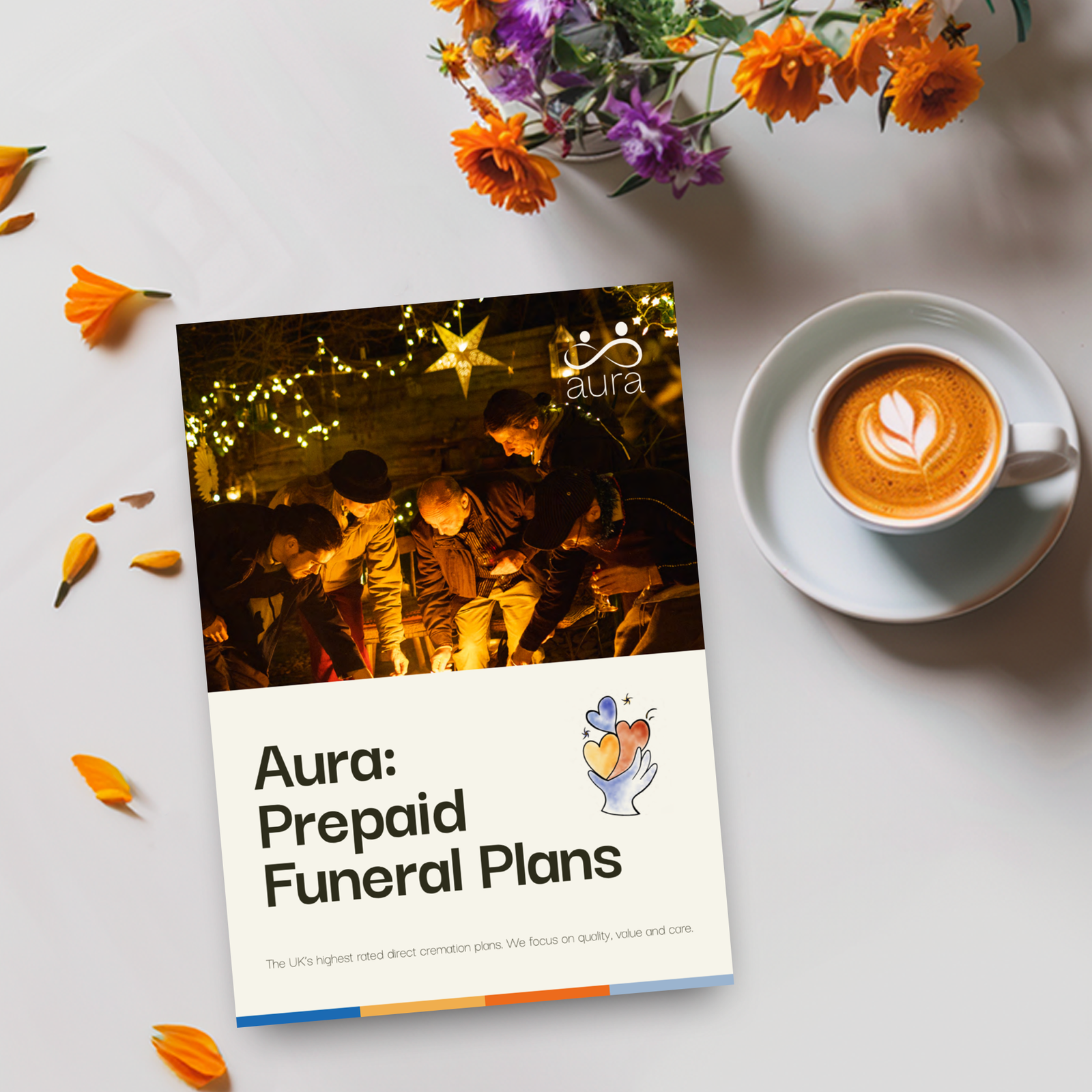
If you’d like to know more about how to plan a cremation with Aura, our brochure is a helpful place to begin.
Our funeral plans are a helpful way to put everything in place for you or someone else.
When the time comes, our experienced team will be here to guide you through each step, offering support and advice whenever you need it.
To find out more about how our plans work, what’s included, and our story, you can request a brochure by clicking the link below. We will then send you a copy by email or First Class post—whichever you prefer.
No. In the UK, it’s not typical to bring flowers to a funeral personally. Most floral tributes are delivered directly to the venue before the service. If flowers are welcomed, they should be ordered in advance or sent to the family’s home as a sympathy gesture.
It depends on your relationship and the type of service. Immediate family often arranges coffin sprays or large displays, while friends or colleagues might choose hand-tied bouquets, standing sprays, or sympathy flowers sent to the home. Personal favourites or flowers with symbolic meaning are also thoughtful choices.
Yes, but the style and size may differ. Smaller, modest arrangements like sheaves or baskets are often more appropriate for cremations. For unattended direct cremations, consider sending sympathy flowers to the family afterward, or opt for an alternative tribute like a donation or memory book.
Keep it simple and heartfelt. Common phrases include “In loving memory,” “With deepest sympathy,” or “Forever in our hearts.” You can also personalise it with a short message of gratitude or remembrance. For groups, sign off collectively (e.g. “From all at [Company Name]”).
If flowers aren’t appropriate or the family has requested otherwise, meaningful alternatives include:
– Charitable donations in memory of the person
– Memory books or handwritten letters
– Planting a tree or wildflowers
– Personal keepsakes or digital tributes
– Eco-friendly arrangements using seasonal or biodegradable options